







What's Happening?
Japanese household spending experienced its fastest annual decline in two and a half years in July, dropping by 3.6% year-on-year. This marks the eighth consecutive month of decrease, according to government data. The decline was worse than the median
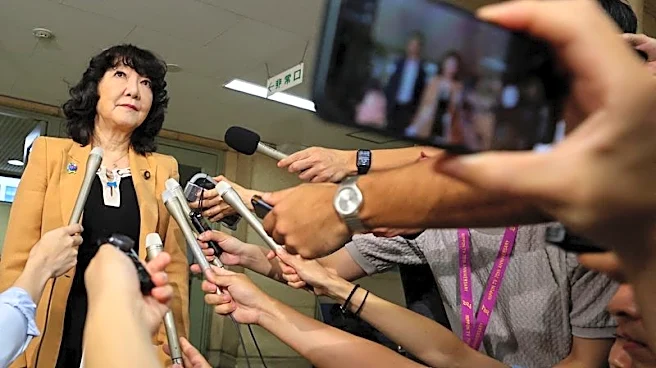
forecast of a 1.6% drop, with spending falling at the steepest rate since January 2024, when it saw a 6.3% decrease. On a seasonally adjusted month-on-month basis, spending edged up by 0.5%, which was below the forecasted 2.6% jump. A ministry official noted that consumers are being selective, increasing outlays on entertainment and household goods while reducing spending on food and transportation. While the official did not directly attribute the decline to rising costs, analysts suggest that consumers are feeling the pinch from higher prices with no immediate relief in sight. Masato Koike, senior economist at Sompo Institute Plus, indicated that despite large wage hikes this year, downward pressure on consumption is expected to intensify as higher prices become more pronounced.
Why It's Important?
The sustained decline in Japanese household spending is a critical indicator for the Bank of Japan (BOJ) as it considers potential interest rate adjustments. Weak private consumption could signal a fragile economic recovery, making the BOJ hesitant to tighten monetary policy. While the data itself might not be the sole determinant, it will be a significant factor in the BOJ's upcoming decision on whether to raise interest rates as early as this month. A cautious approach by the BOJ could impact global financial markets, as Japan's monetary policy often influences international investment flows and currency valuations. For U.S. businesses with operations or significant trade ties in Japan, a prolonged period of weak consumer spending could translate to reduced demand for their products and services, potentially affecting their revenue and growth projections in the region. Furthermore, if Japan's economic struggles deepen, it could contribute to broader global economic uncertainties, indirectly affecting U.S. economic stability.
What's Next?
The Bank of Japan will closely scrutinize the consumer spending data, alongside other economic indicators, as it prepares for its upcoming monetary policy meeting. The decision on whether to raise interest rates, potentially as early as this month, will be heavily influenced by the BOJ's assessment of the overall economic landscape, including the trajectory of inflation and consumer behavior. Analysts anticipate that if the trend of declining household spending continues, it could lead the BOJ to maintain its current ultra-loose monetary policy for longer than expected, or at least proceed with extreme caution regarding any rate hikes. Businesses and consumers in Japan will be watching for any government interventions or stimulus measures aimed at boosting domestic demand. The annual core inflation in Tokyo, which accelerated for the third consecutive month in August, will also be a key factor, as broadening price pressures could further impact consumer purchasing power and spending habits.
Beyond the Headlines
The persistent decline in household spending in Japan, despite recent wage hikes, highlights a deeper challenge related to consumer confidence and the perceived value of money in an inflationary environment. This situation could lead to a shift in consumer psychology, where discretionary spending is curtailed even when incomes rise, as individuals prioritize saving or essential goods due to uncertainty about future price increases. This trend could have long-term societal implications, potentially altering consumption patterns and investment behaviors. From a global perspective, Japan's economic struggles could serve as a cautionary tale for other developed nations grappling with inflation and the delicate balance between economic growth and price stability. The emphasis on selective spending, favoring entertainment and household goods over food and transportation, also points to evolving consumer priorities and potentially a re-evaluation of lifestyle choices in response to economic pressures.