



What's Happening?
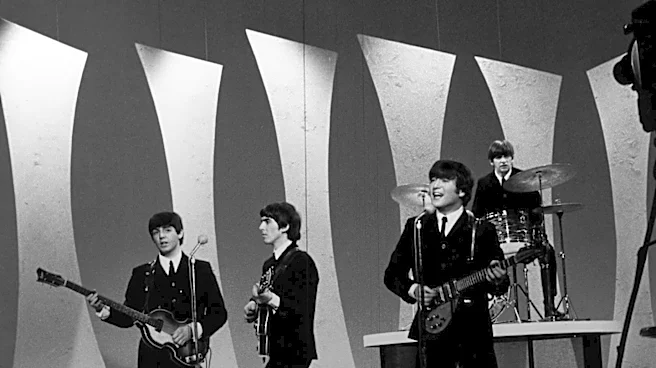
On February 9, 1964, approximately 73 million Americans, nearly two out of every five people in the country, tuned into CBS's 'The Ed Sullivan Show' to watch The Beatles perform. This event, which saw the band's sound often drowned out by the continuous
screaming of teenage fans, confirmed a phenomenon already underway, as their song 'I Want to Hold Your Hand' had topped American charts the week prior. The appearance was booked by Ed Sullivan after he witnessed the immense crowd reaction to the band at London Airport in October 1963. The Beatles, who had honed their craft for years, including extensive residencies in Hamburg, Germany, were managed by Brian Epstein, who transformed their image and secured their record deal with Parlophone producer George Martin. Their second single under Martin, 'Please Please Me,' quickly rose to the top of British charts.
Why It's Important?
The Beatles' arrival in the U.S. coincided with a significant demographic shift: the leading edge of the post-World War II baby boom generation, born in 1946, turned eighteen in 1964. This cohort represented an unprecedented market of young people with disposable income, a phenomenon amplified by the widespread availability of cheap, portable transistor radios. These devices allowed music to become a private possession for teenagers, rather than a shared family experience. Furthermore, the ubiquity of television sets, present in nine out of ten households, enabled a national sensation to occur simultaneously across the country. The Ed Sullivan Show appearance demonstrated the power of mass media to unite a vast audience, momentarily fusing the country around a single event and highlighting the emergence of the teenager as a distinct economic and cultural actor.
What's Next?
The immediate aftermath of The Beatles' U.S. debut saw a rapid acceleration of cultural changes that were already nascent in American society. The band, and those who followed in their wake, acted as a conduit, swiftly introducing minority currents such as drug experimentation, Eastern religion, and a loosening of social norms from bohemian enclaves into mainstream teenage bedrooms. This 'British Invasion' also fundamentally altered the music industry, shifting creative control and financial power from professional songwriters and session musicians to self-contained bands who wrote and performed their own material. The success of The Beatles also initiated a creative feedback loop within the industry, notably inspiring American artists like Brian Wilson of The Beach Boys, leading to the development of the album as a cohesive artistic statement and paving the way for 'serious' rock music and FM radio.
Beyond the Headlines
The impact of The Beatles extended beyond music, acting as a powerful 'propulsive' force that influenced art, fashion, and movies. Their ability to move cultural trends from the margins to the center, such as their embrace of the Maharishi and Indian music, demonstrated a significant causal role in shaping the counterculture. However, the direction of this cultural momentum was ultimately determined by broader societal forces, not solely by the band. While the surface of the 1960s roared with revolt, a significant portion of the U.S. remained conventional, as evidenced by the continued popularity of traditional music and the re-election of President Nixon by a landslide. This period highlights the complex interplay between cultural catalysts and underlying societal structures, where a powerful new force can accelerate change while simultaneously encountering deeply entrenched norms.