








What's Happening?
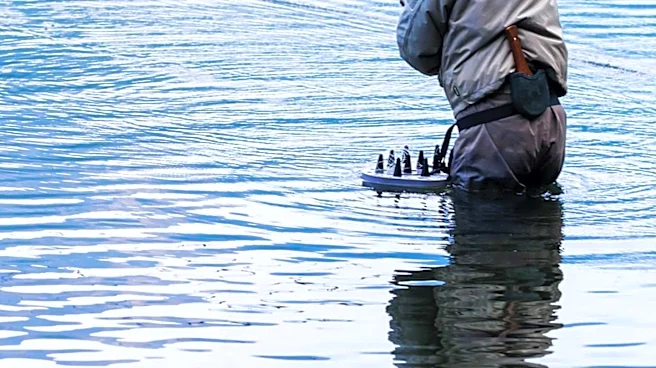
Fly fishing, often romanticized in popular culture, is presented as a challenging activity that demands patience, technical skill, and meticulous attention to detail, much like the process of writing fiction. The core of fly fishing involves tricking
fish into believing an artificial fly is real, requiring precision in fly design, casting, line management, and drift. Similarly, novelists strive for verisimilitude, making their narratives believable through careful crafting of dialogue, setting, character development, and gestures. Both endeavors require specific conditions and the right tools, with fly fishers valuing their waders, vests, and fly boxes, while writers often have their preferred pens, notebooks, and creative environments. The author recounts personal experiences, including a wasp sting during a fly fishing trip, drawing parallels to the 'pain' of writing a novel until it 'transforms into something beautiful.'
Why It's Important?
This comparison between fly fishing and writing fiction highlights the universal principles of dedication, precision, and resilience required in creative and skill-based pursuits. For individuals engaged in artistic or technical fields, the analogy underscores the importance of mastering foundational skills, adapting to challenges, and maintaining patience through iterative processes. In a broader sense, it emphasizes that success in complex tasks often comes from a deep understanding of details and an ability to 'read the water' or 'match the hatch'—metaphors for understanding one's audience and environment. This perspective can inspire a more thoughtful approach to problem-solving and skill development, encouraging individuals to embrace the learning curve and find beauty in the struggle, whether in a creative endeavor or a recreational activity. The narrative also subtly promotes the value of outdoor activities for personal growth and reflection.
What's Next?
The insights drawn from fly fishing can be applied to various learning and creative processes. Individuals seeking to improve their skills in any complex domain might benefit from adopting the methodical and patient approach described. For aspiring writers, the analogy suggests focusing on foundational elements like sentence structure and character development, much like a fly fisher perfects their cast. The continuous refinement and adaptation, or 'mending the line,' are crucial for overcoming obstacles and achieving desired outcomes. This perspective encourages a long-term view of skill acquisition, where setbacks are seen as opportunities for learning and improvement, ultimately leading to a more polished and authentic final product, whether it's a novel or a successful fishing trip.
Beyond the Headlines
The deeper implication of this comparison lies in the philosophical connection between human endeavor and the natural world. Fly fishing, set in 'some of the world’s most breathtaking places,' offers a spiritual dimension, emphasizing the importance of being present and connected to nature. This connection can foster a sense of humility and respect for the environment, which is increasingly vital in a rapidly changing world. The act of 'trickery' in fly fishing, when viewed through the lens of verisimilitude in writing, speaks to the human desire to create believable realities, whether on the page or in an interaction with nature. This exploration of patience, authenticity, and the pursuit of beauty in both art and outdoor recreation offers a rich tapestry of human experience, suggesting that the lessons learned in one domain can profoundly enrich another.