







What's Happening?
U.S. equity futures are showing a modest rebound after a recent sharp selloff, particularly affecting technology stocks and broader risk assets. Nasdaq 100 futures rose approximately 0.52%, S&P 500 futures gained about 0.35%, and Dow and Russell futures also
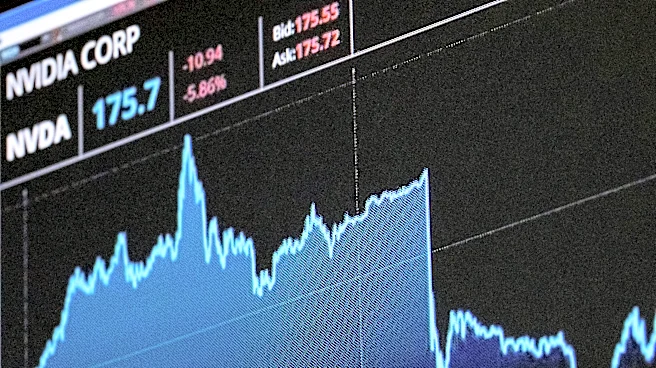
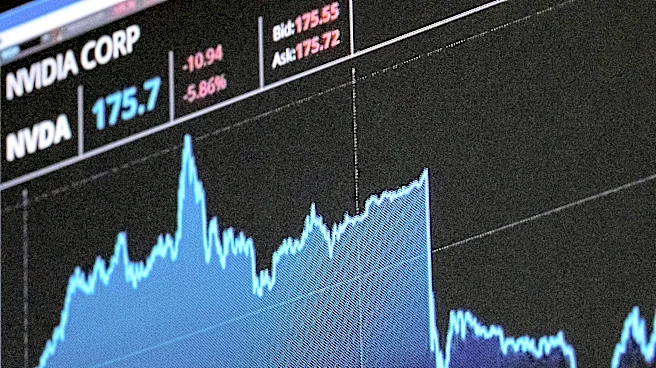
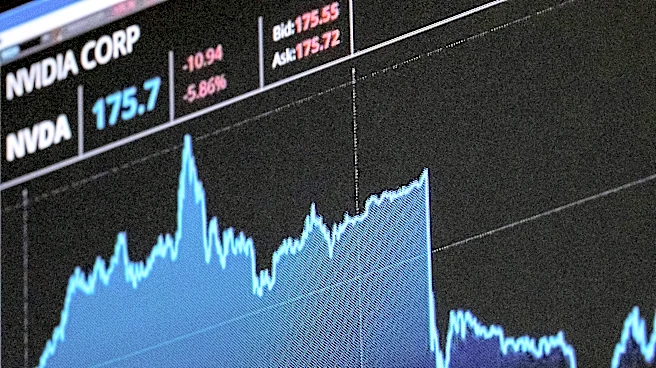
saw slight increases in Asian trading. This rebound follows a period of weakness driven by several factors, including rising government bond yields, which climbed above 5% for the 10-year Treasury yield. Investors are concerned that persistent inflation might lead the Federal Reserve to maintain restrictive policies or consider further rate increases. Technology stocks, in particular, faced company-specific uncertainty, with Nvidia becoming a focal point after reports concerning CEO Jensen Huang's departure triggered a sharp reaction in the semiconductor sector. While the stock recovered some losses, it intensified concerns about market concentration and leadership risk within the artificial intelligence sector.
Why It's Important?
The cautious rebound in U.S. equity futures is significant for investors and the broader U.S. economy. Rising Treasury yields make equities less attractive, especially growth stocks whose valuations are heavily dependent on future earnings. When yields increase, the present value of these future cash flows declines, putting pressure on companies with high valuations. This dynamic disproportionately affects the technology sector, which has been a major driver of market growth. The uncertainty surrounding key technology companies like Nvidia, a leader in artificial intelligence, can create ripple effects across the market, impacting investor confidence and capital allocation. A sustained recovery would require broader market participation beyond mega-cap technology shares, indicating a healthier economic outlook. The Federal Reserve's monetary policy decisions, influenced by inflation data, will continue to be a critical factor shaping market sentiment and investment strategies.
What's Next?
Traders and investors are closely monitoring several key signals to determine the market's future direction. The 10-year Treasury yield remains a crucial indicator; if it continues to climb, equity valuations may stay under pressure. Conversely, a decline in yields, especially if it reflects easing rate concerns, could provide room for growth stocks to recover. Another critical signal is technology-sector breadth, with traders looking for a broad recovery across semiconductors, software, cloud computing, and hardware, rather than just a few large names. Market volatility will also be watched, as large intraday swings often indicate investors are trying to establish a new price range. The relationship between major indexes, such as Nasdaq, Dow, and Russell, will offer insights into risk appetite across different market segments. A sustained recovery would involve several sessions of consistent buying, improved market breadth, and stabilized Treasury yields.
Beyond the Headlines
The current market dynamics underscore a deeper tension between technological innovation and macroeconomic stability. The concentration of market gains in a few mega-cap technology companies, particularly those in artificial intelligence, creates a vulnerability where company-specific events can have outsized market impacts. This raises questions about market diversification and the potential for systemic risk if these leading companies face significant headwinds. Furthermore, the Federal Reserve's balancing act between controlling inflation and supporting economic growth continues to influence investment decisions across all sectors. The long-term implications include a potential shift in investment strategies towards more diversified portfolios and a greater emphasis on companies with strong fundamentals that are less sensitive to interest rate fluctuations. The market's reaction to leadership changes in key tech firms also highlights the importance of corporate governance and succession planning in maintaining investor confidence.