


What's Happening?
Suyuan Matrix, a Beijing-based startup specializing in AI systems for materials manufacturing, has successfully raised US$4.13 million (approximately $4.51 million) in an angel funding round. The investment was led by Koala Fund, with participation from
Zhongguancun Science City and the Beijing Institute for Scientific Intelligence. Duowei Capital served as the exclusive financial adviser for the transaction. Suyuan Matrix, also known as EcoMatrix, aims to revolutionize materials manufacturing by developing a native AI agent that integrates materials science with process knowledge. This technology is designed to transition manufacturing from a 'trial and error' approach to one based on predictable results. The company plans to use the funds to develop cross-scale AI4S models, establish an 'AI Science Factory,' and expand its research and engineering teams.
Why It's Important?
This investment signifies a growing trend in the application of artificial intelligence to industrial processes, particularly in materials manufacturing. For U.S. industries, this development highlights the increasing global competition in advanced manufacturing and the critical role AI will play in optimizing production. The shift from traditional, empirical methods to AI-driven prediction and validation can lead to significant improvements in efficiency, cost reduction, and the development of novel materials. U.S. companies in manufacturing, materials science, and AI development will need to monitor these advancements closely to maintain competitiveness. The success of companies like Suyuan Matrix could accelerate the adoption of similar AI-driven manufacturing paradigms globally, impacting supply chains and technological leadership.
What's Next?
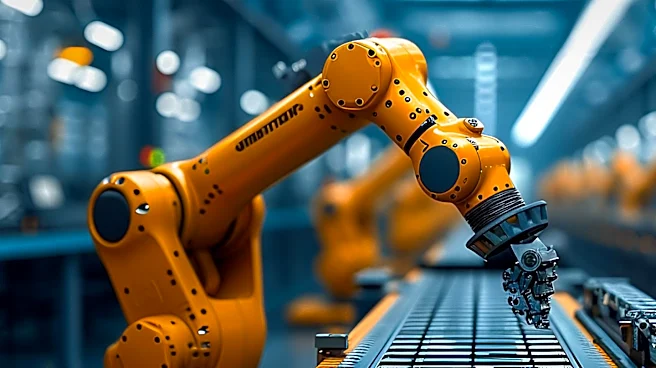
Suyuan Matrix intends to use the newly acquired funds to further develop its cross-scale AI4S models and establish its 'AI Science Factory.' This factory is envisioned as a platform that transforms real production lines into high-throughput testing environments, capable of both manufacturing materials and designing new ones. The company will also focus on hiring additional research and engineering staff to support these initiatives. The immediate future will involve proving the commercial viability of their approach by demonstrating the ability to effectively link materials prediction with experimental validation and manufacturing, and then delivering repeatable results for customers. This move indicates a broader industry trend towards integrating AI directly into industrial production rather than limiting it to laboratory research.
Beyond the Headlines
The investment in Suyuan Matrix reflects a strategic bet on the 'factory floor' as the next frontier for materials AI, moving beyond purely theoretical research. This has deeper implications for the future of manufacturing, suggesting a paradigm shift where AI not only optimizes existing processes but also actively participates in the design and innovation of new materials. Ethically, this raises questions about the role of human expertise in a highly automated design and manufacturing environment. Legally, intellectual property rights for AI-designed materials could become a complex area. Culturally, it represents a continued blurring of lines between scientific discovery and industrial production, potentially leading to faster innovation cycles but also demanding new skill sets from the workforce and a re-evaluation of traditional manufacturing roles.