








What's Happening?
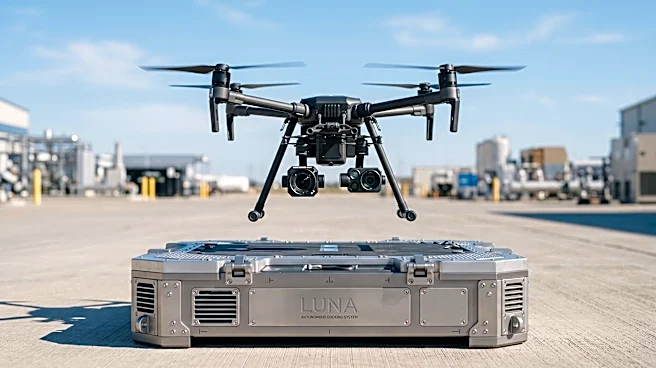
Miami-based autonomy company Hextronics introduced its new Eclipse, a vertically integrated drone dock and aircraft system, at the Commercial UAV Expo in Las Vegas. The Eclipse system comprises three main components: Hexair, Luna, and Helios. Hexair is the operational
cockpit software, enabling remote and secure drone and dock control, data management, and mission logging, with an open API for custom applications. Luna is the physical dock, designed for simplicity and reliability, featuring industrial-grade HVAC for harsh climates and a compact footprint. The Helios is Hextronics' new drone, boasting an industry-leading flight time of over 50 minutes, an unobstructed range of six miles using both radio and cellular communications, and a top speed of 60 mph. The Helios drone's payload, named Trinity, includes two 20-megapixel narrow and telephoto lenses with over 80 times zoom, available in a T variant with radiometric thermal imaging and a V variant with a low-light sensor for night vision. The system is designed to address the operational bottleneck of requiring a pilot on-site for drone launch, landing, and recharging.
Why It's Important?
The Eclipse system represents a significant advancement in drone autonomy and infrastructure, particularly for industrial inspection, public safety agencies, and critical infrastructure operators. By integrating the drone, dock, and software into a single system, Hextronics aims to remove the friction associated with combining components from multiple vendors, thereby increasing efficiency and reducing operational complexities. The extended flight time and range of the Helios drone, coupled with the robust and climate-resilient Luna dock, enable longer, more autonomous missions without constant human intervention. This vertical integration and focus on reliability are crucial for expanding the practical applications of drones, transforming them from individual tools into standing infrastructure. The open API of the Hexair software also promotes customization and adaptability, allowing various industries to tailor the system to their specific needs and use cases.
What's Next?
Hextronics is positioning Eclipse as a solution that will enable agencies and enterprises to view autonomy as a routine utility rather than a future capability. The company anticipates that the system's ability to automate launch, data capture, and recharge cycles will significantly reduce staffing burdens, making drone operations more accessible and scalable. The ongoing evolution of U.S. airspace regulations, including National Defense Authorization Act compliance and expanding FAA allowances for beyond-visual-line-of-sight operations, will continue to shape the adoption and deployment of such integrated drone systems. Hextronics' focus on alignment across capability, scale, cost, payload, uptime, and performance suggests a continued effort to refine and expand the Eclipse ecosystem to meet diverse operational demands and regulatory requirements.
Beyond the Headlines
The shift towards vertically integrated drone systems like Eclipse signifies a broader trend in the technology sector towards comprehensive, end-to-end solutions. This approach not only streamlines deployment and maintenance but also fosters greater control over the entire operational chain, potentially leading to enhanced security and reliability. The concept of drones as 'standing infrastructure' rather than 'one-off tools' could revolutionize various industries, from logistics and surveillance to environmental monitoring and emergency response. However, this also raises questions about data privacy, ethical use of autonomous surveillance, and the potential impact on human employment in tasks traditionally performed by on-site personnel. The success of such systems will depend not only on technological prowess but also on public acceptance, regulatory frameworks, and the ability to address societal concerns.