







What's Happening?
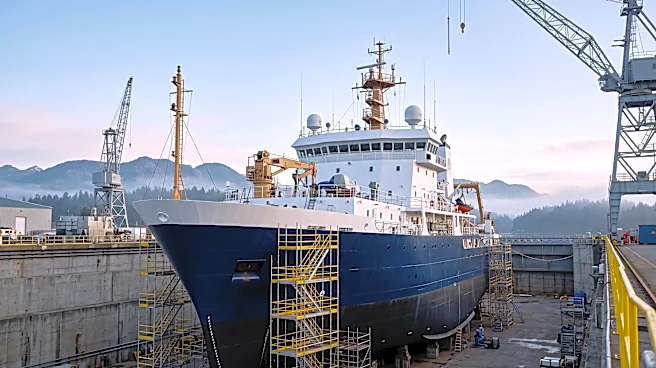
The NOAA Ship Oscar Dyson has arrived at the Ketchikan Shipyard in Alaska to undergo a significant modernization project, backed by a $95.4 million federal contract. This project is part of a broader initiative by JAG Ketchikan LLC, which operates the shipyard,
to expand its capabilities and workforce. The Oscar Dyson, commissioned in 2005, is crucial for collecting data vital to managing Alaska's pollock fishery, one of the world's largest commercial fisheries. The overhaul, expected to conclude by December 5, 2027, includes replacing the propulsion system with variable-speed Tier 4 generators, installing quieter air-conditioning motors, and upgrading various equipment such as pumps, fans, cranes, fire detection systems, and radars. Additionally, the project will increase the number of single-person staterooms on the vessel. This federal contract follows another $99.6 million NOAA contract awarded to JAG Alaska Inc. for the modernization of the research vessel Henry B. Bigelow, bringing the total federal vessel modernization work at the shipyard to approximately $195 million. The Alaska Industrial Development and Export Authority (AIDEA) noted that employment at the shipyard is projected to reach nearly 200 workers by the end of 2026 due to these contracts.
Why It's Important?
This influx of federal contracts for vessel modernization at the Ketchikan Shipyard is a significant economic boon for Southeast Alaska. The $195 million in federal work not only secures substantial revenue for the region but also creates and sustains numerous skilled jobs in trades, engineering, electrical, mechanical, and fabrication. AIDEA Executive Director Randy Ruaro highlighted that this activity supports more vessels, skilled jobs, and long-term opportunities for the area. The increased employment, expected to approach 200 workers by the end of 2026, directly benefits local communities and families. Furthermore, the modernization of the NOAA Ship Oscar Dyson is critical for the sustainability of the U.S. fishing industry, particularly the Alaska pollock fishery. The improvements to the vessel, such as enhanced fuel efficiency, operational safety, and research capabilities in Alaskan and Arctic waters, ensure that vital scientific data continues to be collected effectively, supporting responsible fisheries management and economic stability for commercial fishing operations. The partnership between AIDEA and JAG Ketchikan LLC demonstrates a successful model for leveraging federal investment to drive regional economic growth and workforce development.
What's Next?
The modernization project for the NOAA Ship Oscar Dyson is scheduled to continue until December 5, 2027, after which the vessel is expected to return to service for the 2028 field season. To ensure continuous research coverage in Alaska during the overhaul, NOAA is modifying the Bell M. Shimada with necessary equipment for operations in Alaskan waters. The separate Henry B. Bigelow Modernization and Revitalization Program will run through April 14, 2029, adding to the shipyard's multiyear workload. JAG Ketchikan is actively focused on expanding the shipyard's capabilities and building a skilled trades workforce to meet long-term maritime demand. Training initiatives, such as the collaboration between JAG Marine Group, Generations Southeast Vocational Training Center, Tlingit & Haida, Sealaska, and state partners, are underway to connect Alaskans with shipyard careers. AIDEA is also pursuing federal funding for a proposed third dry dock, which would further expand the shipyard's capacity to accommodate larger vessels like icebreakers and Navy ships, potentially adding 303 jobs and generating an estimated $148 million in annual economic activity for the region.
Beyond the Headlines
The ongoing federal investment in the Ketchikan Shipyard extends beyond immediate economic benefits, signaling a strategic commitment to bolstering U.S. maritime infrastructure and scientific research capabilities. The modernization of vessels like the Oscar Dyson underscores the critical role of federal contracts in sustaining specialized industries and fostering technological advancements in shipbuilding. This initiative also highlights the importance of public-private partnerships, such as that between AIDEA and JAG, in driving regional development and creating a skilled workforce. The focus on training Alaskans for these positions addresses broader societal goals of local empowerment and economic self-sufficiency. Furthermore, the potential expansion with a third dry dock could position Ketchikan as a key hub for servicing a wider range of vessels, including those with national security implications like icebreakers and Navy ships, thereby enhancing the nation's strategic presence and operational readiness in the Arctic. This long-term vision for the shipyard reflects a comprehensive approach to economic development, workforce training, and national strategic interests.