

What's Happening?
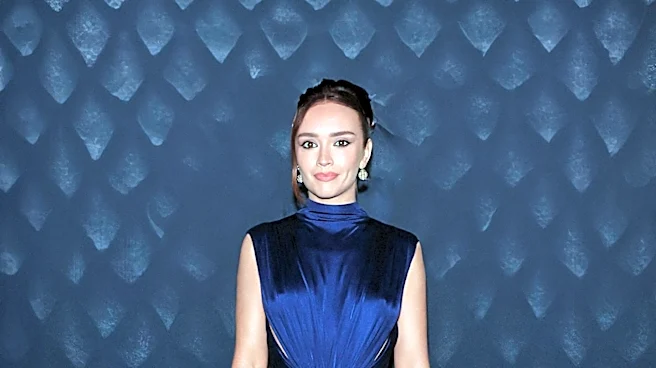
Olivia Cooke, who portrays Queen Alicent Hightower in HBO’s 'House of the Dragon,' has revealed she took a break from social media due to the 'ugliness' of the show's fandom. Ahead of the third season's premiere, Cooke deactivated her accounts, describing
the online discourse as 'steeped in misogyny' and 'racism.' She noted that many fan interpretations of the show's content, particularly concerning her character and her interactions with directors, became distorted and bore no resemblance to the on-screen reality. Cooke emphasized her effort to minimize the mental impact of this negative online environment. This decision aligns with her focus on mental health and a desire to distance herself from the 'celebri-fied nature' of being an actor, which she believes has become a 'monster' driven by followers and brand deals rather than artistic creation. Other actors in the 'Game of Thrones' universe, such as Sophie Turner, have also spoken about the detrimental effects of social media on their mental well-being.
Why It's Important?
This situation highlights a growing concern within the entertainment industry regarding the impact of intense and often toxic fan culture on actors' mental health and professional lives. The 'House of the Dragon' fandom's alleged misogyny and racism, as described by Cooke, underscore broader societal issues that manifest in online communities. For actors, the constant scrutiny and misinterpretation of their roles and personal lives can lead to significant psychological distress, prompting them to withdraw from public platforms. This trend could influence how actors engage with their audiences and potentially lead to more guarded public personas. Furthermore, it raises questions about the responsibility of social media platforms and fan communities in fostering healthier environments, especially for high-profile individuals. The experience of actors like Cooke and Sophie Turner suggests a need for greater awareness and strategies to protect performers from the darker aspects of online fandom.
What's Next?
As actors continue to navigate the complexities of social media and fan engagement, there may be a shift towards more controlled or limited online presences. Cooke's decision to return to Instagram but maintain a greater distance from it suggests a potential model for managing public interaction while protecting personal well-being. The entertainment industry might also explore new ways to support its talent in dealing with online harassment and toxic fandoms. This could include providing resources for mental health, offering guidance on social media management, or advocating for stricter platform policies against abusive behavior. The ongoing dialogue about fan culture's impact could also encourage a re-evaluation of how shows are promoted and how fan communities are moderated, aiming to cultivate more respectful and constructive engagement.
Beyond the Headlines
The experiences shared by Olivia Cooke delve into the ethical and cultural dimensions of modern celebrity and fan interaction. The blurring lines between fictional characters and the actors who portray them, coupled with the anonymity of online platforms, can create an environment where harmful narratives proliferate. This phenomenon extends beyond the entertainment industry, reflecting broader challenges in digital communication where misinformation and personal attacks can quickly gain traction. The discussion also touches upon the commercialization of celebrity, where an actor's worth can sometimes be measured by their social media following rather than their artistic merit. Cooke's call to remember that filmmaking is 'artful and creative' rather than solely for 'followers or for a brand deal' serves as a critical reminder of the core purpose of artistic endeavors, challenging the prevailing metrics of success in the digital age.