





What's Happening?
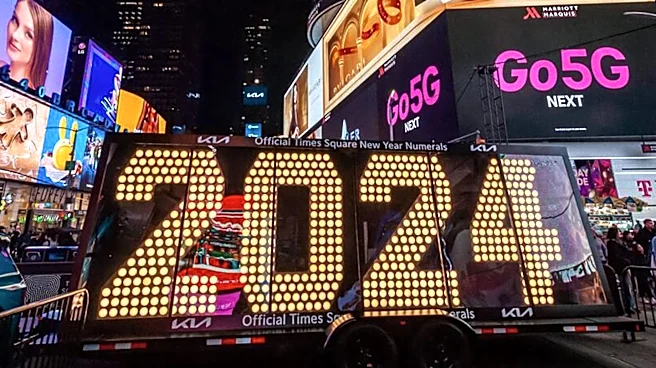
Adobe executed its largest AI-powered creative showcase to date with a massive takeover of Times Square for its Firefly 'Just Imagine' campaign. The event involved 38 individual screens across six New York City blocks, synchronized to display 392 unique
Firefly images and videos, totaling 3.8 hours of unique content and over 3 million rendered frames. This generated 20 terabytes of data. The content was sourced from Adobe employees, the community, and 23 influencers, along with eight artists who created on-site content. The takeover also featured interactive street-level activations, including 20 self-serve stations where visitors could use Firefly to personalize selfies and see their creations displayed on large LED 'Dream Boards.' Adobe utilized Firefly's text-to-image, image-to-video, and image editing capabilities, along with the Firefly API, to rapidly generate and adapt hundreds of bespoke visual assets for the complex, multi-screen environment.
Why It's Important?
This Times Square takeover is a significant demonstration of the capabilities of AI-powered creative tools at an unprecedented scale. It showcases how artificial intelligence, specifically Adobe Firefly, can revolutionize content creation by enabling rapid ideation, iteration, and production of vast amounts of diverse visual assets. For the advertising and marketing industries, this event highlights a new frontier in campaign execution, where AI can facilitate highly dynamic, personalized, and immersive brand experiences. It also underscores the potential for AI to democratize creativity, allowing a wider range of individuals—from influencers to the general public—to generate high-quality visual content. The sheer volume and complexity of the synchronized display in Times Square serve as a powerful proof-of-concept for AI's role in large-scale media productions, potentially setting new benchmarks for creative output and efficiency in the U.S. market and beyond.
What's Next?
The success of Adobe's Firefly Times Square takeover is likely to inspire other brands and creative agencies to explore similar large-scale, AI-driven marketing campaigns. We can expect an acceleration in the adoption of AI tools for content generation, particularly in high-visibility advertising spaces. This could lead to more dynamic and interactive digital billboards, experiential marketing events, and personalized advertising content across various platforms. Adobe will likely continue to enhance Firefly's capabilities, potentially integrating more advanced AI features and expanding its API to foster broader developer adoption. The event also signals a growing trend where AI is not just a backend tool but a front-facing component of brand engagement, inviting consumers to directly interact with AI-powered creative processes. This could lead to new forms of user-generated content and co-creation between brands and their audiences.
Beyond the Headlines
Beyond its marketing spectacle, this event touches upon deeper implications regarding the future of creativity, technology, and public engagement. Ethically, it raises questions about the authenticity and authorship of AI-generated content, especially when it's co-created with users. It also highlights the evolving relationship between human creativity and artificial intelligence, demonstrating how AI can augment rather than replace human artistic expression. Culturally, the integration of AI into such a prominent public space like Times Square signifies a growing acceptance and normalization of AI in everyday life and media consumption. This could lead to shifts in how audiences perceive and interact with digital art and advertising, potentially fostering new aesthetic sensibilities. Legally, the rapid generation of content by AI tools at scale may prompt new discussions around copyright, intellectual property, and content moderation in the context of AI-driven creative output, especially as user-generated AI content becomes more prevalent in public displays.