


What's Happening?
The Port of Cleveland has approved financing for four significant development projects totaling an estimated $153 million. These projects, announced after a board meeting on November 12, 2026, include a modular-housing factory, an affordable housing community,
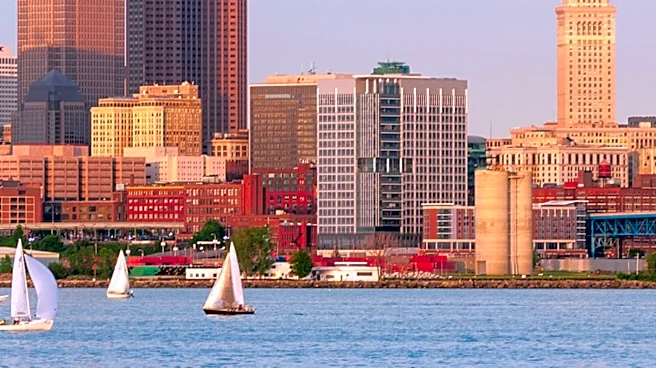
an industrial building for a long-standing Cleveland company, and a large riverfront amphitheater. The modular-housing factory, MMY US Inc., will redevelop the historic Wellman-Seaver-Morgan Engineering Company building, a $25.7 million investment expected to create 150 manufacturing jobs. The affordable housing project, Midtown Lofts (Mingyue Place) in AsiaTown, will feature 120 affordable units and a Cleveland Public Library branch, with the Port authorizing up to $30 million in bonds for its $42.3 million construction. Gateway 55 involves a new 166,000-square-foot industrial building for Reese Consumer Health, retaining 64 jobs and creating 36 more, backed by up to $26 million in bonds for its $25 million cost. The largest project, the Cleveland Amphitheater, is a 6,200-seat outdoor venue on the Cuyahoga River waterfront, with an estimated cost of $52 million.
Why It's Important?
These approvals signify a major investment in Cleveland's economic and social infrastructure, aligning with the Port's upcoming strategic plan for early 2027. The projects address critical needs in the city, including job creation, affordable housing, and urban revitalization. The modular-housing factory will bring advanced manufacturing jobs and potentially boost local exports. The affordable housing development in AsiaTown will provide much-needed housing options for low-to-moderate-income households and enhance community services with a new library branch. The Gateway 55 project ensures the retention and expansion of a 120-year-old Cleveland company, preserving local jobs and industrial heritage. The riverfront amphitheater is poised to transform the Cuyahoga River waterfront into a vibrant entertainment hub, attracting visitors and generating significant employment in construction and operations. Collectively, these initiatives aim to foster economic growth, improve quality of life for residents, and enhance Cleveland's appeal as a place to live, work, and visit.
What's Next?
Construction timelines vary for each project. The Midtown Lofts development in AsiaTown could see a groundbreaking as early as December 2026. For Gateway 55, construction is anticipated to begin in January 2027, pending city and county approvals, with completion expected by December 2027. The Cleveland Amphitheater project is slated to begin construction in November 2026, with an estimated completion and opening in summer 2028. The Port of Cleveland is also preparing to release its new strategic plan in early 2027, which will further outline its priorities and future development initiatives. These projects are expected to generate substantial employment, with the amphitheater alone projected to create 525 construction jobs and support 350 operational jobs. Mayor Justin M. Bibb has indicated that these projects advance his Cleveland ERA agenda, highlighting the collaborative effort between the Port and city leadership.
Beyond the Headlines
The Port of Cleveland's multi-faceted investment reflects a broader trend in urban development focusing on integrated solutions for economic growth and community well-being. By backing projects that span manufacturing, affordable housing, business retention, and entertainment, the Port is demonstrating a comprehensive approach to urban revitalization. The redevelopment of historic industrial sites, like the Wellman-Seaver-Morgan Engineering Company building, showcases a commitment to preserving heritage while fostering modern industries. The inclusion of a library branch within an affordable housing complex highlights a progressive vision for community development that integrates essential services with residential needs. Furthermore, the emphasis on waterfront activation through the amphitheater project underscores the growing recognition of urban riversides as key assets for public engagement and economic activity. These projects could serve as a model for other Rust Belt cities seeking to rejuvenate their economies and improve urban living through strategic, diversified investments.