




What's Happening?
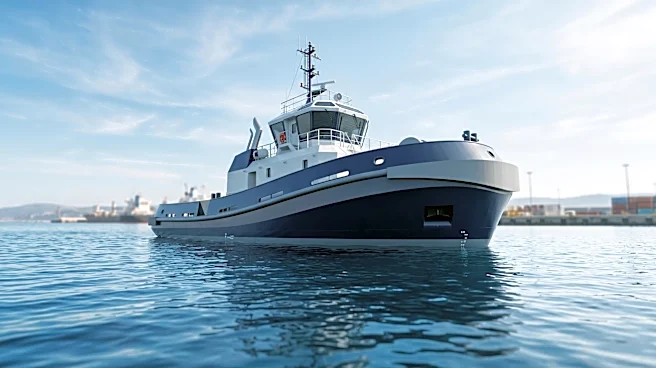
Snow & Company, a Seattle-based shipbuilding firm, has delivered its first all-electric tugboat, named 'Tuuli C,' to a customer. The vessel, unveiled at Bell Harbor Marina, is a ship-assisting e-tug equipped with two 2,000-horsepower all-electric propulsion
units. This delivery marks the first of eight electric boats being constructed for Curtin Maritime, a company based in Long Beach, California. Los Angeles-based Arc is supplying the batteries and integrating the vessel's battery management system. The 'Tuuli C' operates with minimal noise, emitting only 44 decibels. Its launch in April required a larger floating crane, the Derrick 24, due to the tug's weight, as Snow & Company's traditional 1942 steam-powered crane system was insufficient. Arc officials noted that the tug program necessitated adapting their recreational marine battery experience to meet the industrial demands of commercial marine towing, emphasizing their partnership with Snow & Company for critical system interfaces.
Why It's Important?
The delivery of the 'Tuuli C' signifies a notable advancement in the maritime industry's shift towards electrification and sustainability. This all-electric tugboat represents a move away from traditional diesel-powered vessels, contributing to reduced emissions and noise pollution in port environments. For Curtin Maritime, operating these electric tugs could lead to lower fuel costs and compliance with increasingly stringent environmental regulations. The collaboration between Snow & Company and Arc highlights the growing demand for specialized expertise in electric propulsion and battery technology within the commercial marine sector. The use of lithium-iron-phosphate chemistry in Arc's batteries, which offers safety advantages, longer life cycles, and stable voltage, could set a new standard for commercial marine applications, influencing future shipbuilding practices and technological adoption across the industry.
What's Next?
Following the delivery of the 'Tuuli C,' Snow & Company will continue construction on the remaining seven electric tugboats for Curtin Maritime, indicating a sustained commitment to electric vessel production. The performance and operational efficiency of the 'Tuuli C' in real-world commercial towing operations will be closely monitored, potentially influencing future orders and the broader adoption of electric tugs by other maritime companies. Arc's success in adapting its battery technology for industrial marine use could lead to further partnerships and expansion into other segments of the commercial shipping industry. This development may also spur increased investment in charging infrastructure at ports to support the growing fleet of electric vessels, driving innovation in shoreside power solutions and grid integration.
Beyond the Headlines
This development extends beyond immediate operational benefits, signaling a broader transformation in maritime logistics and environmental stewardship. The quiet operation of the 'Tuuli C' could significantly reduce noise pollution in harbors, benefiting marine life and port communities. The shift to electric tugs also underscores a growing global imperative to decarbonize the shipping industry, aligning with international climate goals and national sustainability initiatives. This project could serve as a blueprint for other heavy-duty marine applications, demonstrating the viability of electric propulsion in demanding commercial environments. Furthermore, it highlights the evolving skill sets required in shipbuilding and marine engineering, emphasizing expertise in electrical systems, battery management, and advanced materials, which could foster new educational and workforce development opportunities.