





What's Happening?
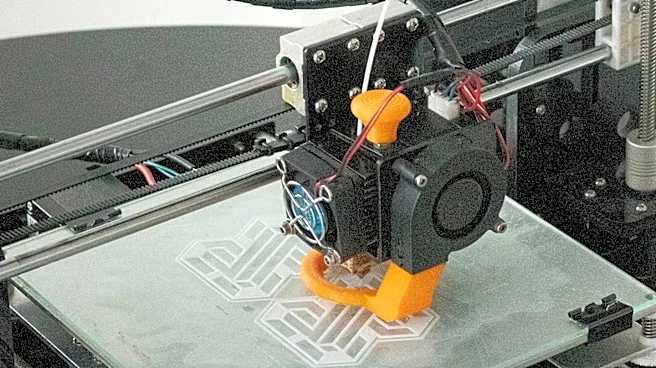
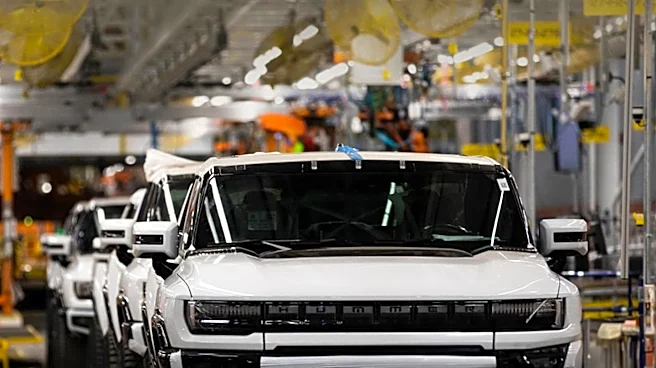
General Motors has integrated industrial 3D printers from Stratasys across more than 20 of its assembly facilities. This deployment enables GM to produce custom manufacturing tools on demand, significantly enhancing its production capabilities. According
to Stratasys's third-quarter 2026 earnings call on November 12, 2026, this strategic move has resulted in a fourfold reduction in tooling turnaround times. Furthermore, the adoption of Stratasys's 3D printing technology is projected to yield substantial operational expense savings for General Motors, with an estimated annual cost reduction of $10 million. This initiative is part of a broader industry trend where manufacturers are shifting towards end-use manufacturing applications for 3D printing, moving beyond rapid prototyping.
Why It's Important?
This collaboration between General Motors and Stratasys underscores a significant shift in the automotive manufacturing industry towards advanced additive manufacturing for production-scale applications. The ability to produce custom tools on demand directly within assembly facilities provides GM with unprecedented agility, reducing lead times and increasing operational efficiency. The reported $10 million in annual cost savings highlights the tangible economic benefits of integrating 3D printing into large-scale manufacturing processes. This move by a major automotive player like GM could accelerate the adoption of similar technologies across the industry, influencing supply chain strategies, tooling development, and overall production methodologies. It also demonstrates the growing maturity and reliability of industrial 3D printing for critical manufacturing tasks.
What's Next?
The successful deployment by General Motors is likely to serve as a case study for other large-scale manufacturers considering the integration of industrial 3D printing. Stratasys, in turn, may leverage this partnership to secure more multisystem factory deals, although management noted that such larger deals often entail longer sales cycles. The focus for both GM and Stratasys will likely be on optimizing the utilization of these printers, expanding their application within GM's operations, and further quantifying the long-term benefits. As more companies witness the efficiency gains and cost reductions achieved by GM, there could be an increased demand for similar solutions, driving innovation and competition within the additive manufacturing sector. Stratasys's long-term value creation will depend on converting pipeline engagement into recurring materials and service revenue from these specialized end-use applications.
Beyond the Headlines
The widespread adoption of 3D printing for on-demand tooling by General Motors signifies a deeper transformation in manufacturing paradigms. It moves towards a more decentralized and agile production model, potentially reducing reliance on external suppliers for specialized tools and mitigating supply chain vulnerabilities. This shift could also foster greater innovation in tool design, allowing for more complex and optimized geometries that were previously unfeasible with traditional manufacturing methods. Environmentally, on-demand local production of tools could lead to reduced waste and transportation emissions. Ethically, it empowers manufacturers with greater control over their production processes, potentially leading to improved quality control and intellectual property protection for proprietary tooling designs. This development marks a significant step towards the 'factory of the future,' characterized by flexibility, efficiency, and advanced digital integration.