
What's Happening?
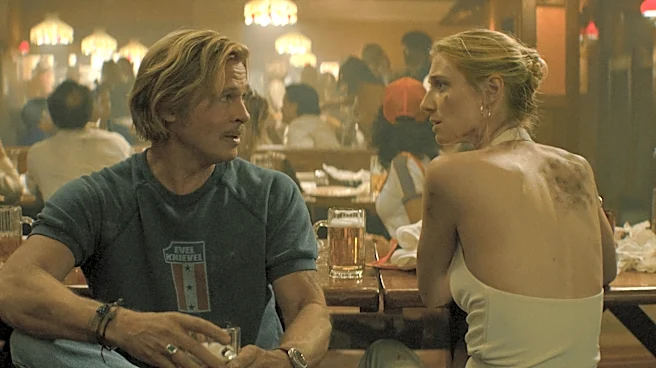
Brad Pitt has returned as Cliff Booth in 'The Further Mis-Adventures of Cliff Booth,' a sequel to Quentin Tarantino’s 2019 film 'Once Upon a Time… in Hollywood.' Directed by David Fincher and written by Tarantino,
the movie elevates Booth from a supporting character to the protagonist. The film is set in the summer of 1977, portraying Hollywood as a quiet town. The narrative follows Cliff Booth as he navigates various odd jobs, from bartender to janitor, after his former associate, Rick Dalton (Leonardo DiCaprio), moves to Australia. The plot is framed by Booth performing favors for celebrities, with the story focusing on his daily life and interactions with new characters, including thieves, brothers, a volatile TV star, and a film critic-turned-agent. The sequel aims to explore the pleasures of being Cliff Booth, relying heavily on Pitt's charismatic performance to maintain audience interest.
Why It's Important?
This sequel is significant for several reasons within the entertainment industry. It marks a notable collaboration between acclaimed directors David Fincher and Quentin Tarantino, bringing together their distinct cinematic styles. For Brad Pitt, reprising his Oscar-winning role offers an opportunity to further develop a character that resonated with audiences, potentially solidifying his legacy in this specific role. The film's setting in 1977 Hollywood provides a nostalgic look at a transitional period in the film industry, just as 'Star Wars' was beginning to reshape the landscape with lucrative family fare and blockbusters. This could spark renewed interest in the era and its cinematic output. The movie's focus on the entertainment business and the life of a stuntman-turned-odd-job-worker also offers a unique perspective on the less glamorous aspects of Hollywood, contrasting with the usual portrayals of stardom and success.
What's Next?
The release of 'The Further Mis-Adventures of Cliff Booth' will likely generate considerable discussion among film critics and audiences, particularly regarding the collaboration between Fincher and Tarantino and the evolution of the Cliff Booth character. The film's reception could influence future projects involving these key figures, potentially leading to more unexpected directorial pairings or character spin-offs. The movie's performance at the box office will also be closely watched, as it could indicate audience appetite for sequels that delve deeper into supporting characters from popular films. Furthermore, the film's portrayal of 1970s Hollywood might inspire other filmmakers to explore similar historical periods or themes, contributing to a broader trend of period pieces in contemporary cinema. The critical analysis of the film's narrative choices, especially the simplification of Cliff Booth's character, will be a key point of discussion.
Beyond the Headlines
Beyond its immediate release, 'The Further Mis-Adventures of Cliff Booth' touches upon deeper themes regarding character evolution and the nature of sequels. The film's decision to simplify Cliff Booth from a complex, contradictory figure to a more straightforward charmer raises questions about how beloved characters are reinterpreted in subsequent narratives. This approach might spark debates about whether character complexity is sacrificed for broader appeal or if it represents a natural progression. The collaboration between Fincher, known for his meticulous and often darker films, and Tarantino, celebrated for his stylized and dialogue-heavy works, also presents an interesting case study in auteur synergy. The film's exploration of the fading relevance of certain entertainment forms in the late 1970s, as depicted through Cliff's projectionist job at a near-empty theater, subtly comments on the cyclical nature of the entertainment industry and the constant shift in audience preferences.