





What's Happening?
Gilead Sciences, a biopharmaceutical company, is highlighted as a key component for investors seeking passive income through dividends. The company's stock has climbed 46.08% year-to-date, contributing to a forward dividend yield of 1.86%. This yield,
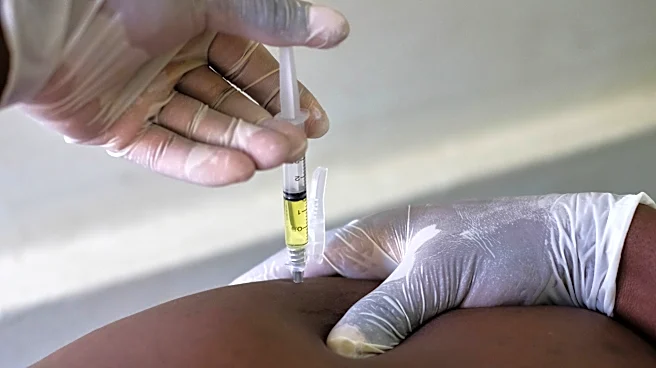
while below 2%, is supported by Gilead's robust HIV franchise, which serves as its primary revenue driver. In the third quarter, HIV sales increased by 18% to $6.25 billion, with Biktarvy alone accounting for $4.06 billion and the twice-yearly PrEP shot Yeztugo contributing $305 million. The quarterly dividend has consistently risen from $0.43 in 2015 to $0.82 in 2026. Despite acquisition-related charges pushing full-year GAAP and non-GAAP guidance into negative territory, illustrative adjusted EPS, excluding these costs, is projected between $8.75 and $9.10, covering the $3.28 annual dividend at approximately 37% of the low end. Third-quarter free cash flow reached $4.80 billion.
Why It's Important?
Gilead's strong HIV franchise provides a stable foundation for its dividend payouts, making it an attractive option for income-focused investors. The consistent growth in HIV sales, particularly from Biktarvy and Yeztugo, demonstrates the enduring demand for its core products and the company's ability to generate substantial cash flow. This financial stability allows Gilead to maintain and increase its dividends, offering a reliable income stream. However, a significant concern for the company and its investors is the anticipated $1.5 billion revenue reduction in 2028 due to Biktarvy’s Medicare negotiated price. This potential impact on revenue highlights the vulnerability of pharmaceutical companies to drug pricing regulations and could influence future dividend growth and stock performance. The ability to diversify revenue streams and manage these pricing pressures will be critical for Gilead's long-term financial health.
What's Next?
The primary challenge for Gilead Sciences in the coming years will be to mitigate the impact of the projected $1.5 billion revenue cut from Biktarvy's Medicare negotiated price in 2028. The company will likely focus on maximizing the sales of its newer HIV prevention drug, Yeztugo, and other pipeline products to offset this reduction. Continued investment in research and development for new therapies and expansion into other therapeutic areas, such as oncology, will be crucial for sustained growth and dividend coverage. Investors will closely monitor Gilead's strategies to navigate the evolving drug pricing landscape and its ability to maintain strong free cash flow to support its dividend policy. The company's performance in diversifying its revenue base will be key to its long-term financial stability and attractiveness to income investors.
Beyond the Headlines
The reliance of Gilead's dividend on its HIV franchise underscores the broader economic implications of pharmaceutical innovation and market dominance. The consistent demand for HIV treatments and prevention drugs creates a robust revenue stream, but also places the company at the forefront of debates surrounding drug pricing and access. The impending Medicare price negotiation for Biktarvy reflects a growing trend towards government intervention in drug costs, which could reshape the financial models of pharmaceutical companies. This situation highlights the delicate balance between rewarding pharmaceutical innovation through market pricing and ensuring affordability and access for patients. For investors, it emphasizes the importance of understanding regulatory risks and pipeline diversification in the biotech sector, beyond just current sales figures.