





What's Happening?
Cisco Systems (CSCO) saw a modest stock pullback in October 2026, trading in the low-to-mid $100s after reaching an early-month peak near $118. This decline, less than 10% over a 30-day period, followed a strong performance earlier in the year driven
by enthusiasm for artificial-intelligence networking. Despite this short-term dip, the company reported strong business momentum, closing fiscal 2026 with record quarterly revenue of approximately $17.3 billion, an 18% year-over-year increase. Non-GAAP earnings per share of $1.22 surpassed consensus estimates. Product orders rose 35% year-over-year, with networking orders climbing 40%. A significant highlight was the growth in AI infrastructure orders from hyperscalers, reaching about $4 billion in the fourth quarter and $9.3 billion for the full fiscal year, a 4.5-fold increase from the previous year. Cisco also projects fiscal 2027 revenue between $72.2 billion and $73.4 billion, with AI infrastructure revenue expected to be around $7.5 billion.
Why It's Important?
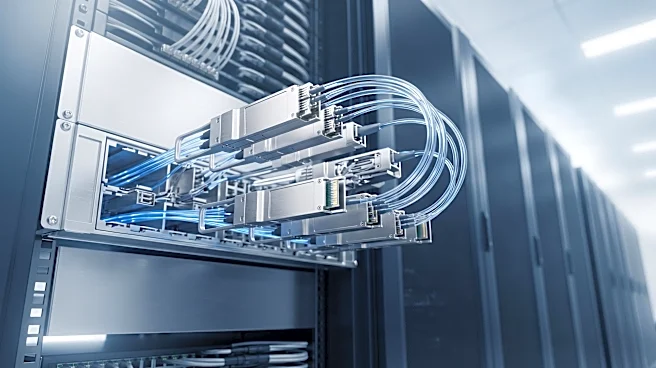
Cisco's stock performance and financial results are significant indicators for the broader technology sector, particularly in networking and AI infrastructure. The company's strong growth in AI-related orders underscores the increasing demand for high-speed Ethernet switching, Silicon One silicon, and optical systems necessary for AI clusters. This positions Cisco as a key beneficiary of the ongoing AI build-out by hyperscalers and cloud providers. The modest stock pullback, despite robust financial results, suggests that market sentiment can be influenced by broader dynamics and profit-taking after strong runs, rather than solely by company performance. This scenario highlights the volatility and investor caution that can accompany rapidly growing sectors like AI. Furthermore, Cisco's guidance for fiscal 2027, including projected AI infrastructure revenue, provides insights into the expected trajectory of investment in AI technologies and the potential for continued growth in this segment.
What's Next?
The next major catalyst for Cisco will be its fiscal first-quarter 2027 report, anticipated around mid-November 2026. Investors will closely monitor this report for revenue figures, which are expected to be near the top of management's $18.0–$18.2 billion guidance range. Gross margins will also be a key focus, given the hardware-heavy mix associated with scaling AI networking shipments, which could introduce a modest headwind. Updates on hyperscaler design wins and the momentum of Cisco's Silicon One technology will provide further insights into the company's competitive position in the AI infrastructure market. Beyond the immediate financial reports, sustained cloud-capital spending on AI data centers and ongoing enterprise and public-sector refresh cycles, including campus switching and Wi-Fi upgrades, will be crucial demand drivers for Cisco's order flow. The company's ability to convert its record order backlog into sustained revenue and margin growth will be a central theme for investors.
Beyond the Headlines
The dynamics observed with Cisco—a stock pullback amidst strong performance driven by AI—point to deeper market trends and investor behavior in the rapidly evolving technology landscape. The 'enthusiasm around artificial-intelligence networking' driving earlier gains, followed by profit-taking, suggests a market grappling with valuation in a high-growth, high-potential sector. This scenario highlights the challenge for investors in distinguishing between fundamental business strength and speculative market movements. Furthermore, Cisco's strategic repositioning as a key player in the AI build-out signifies a broader industry shift where traditional networking companies are adapting their offerings to meet the demands of AI-driven data centers. The competition in data-center networking, particularly with companies like Arista Networks and NVIDIA, underscores the intense innovation and strategic maneuvering required to maintain market leadership in this critical technological frontier. The balance between hardware-heavy AI shipments and overall profitability will be a continuous challenge, potentially influencing future product development and pricing strategies.