



What's Happening?
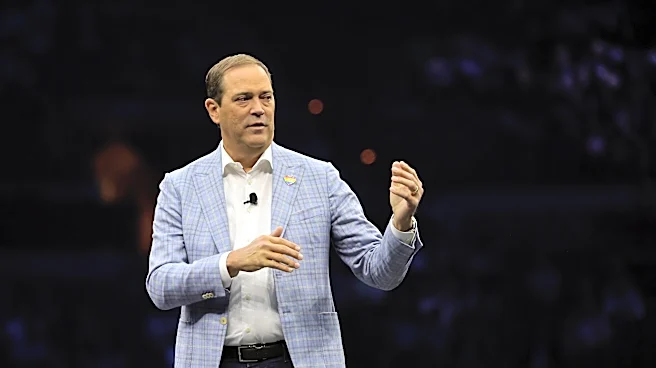
Chuck Robbins, Chair and CEO of Cisco, has been instrumental in transforming the company from a holding company model to an integrated platform company since taking the helm in December 2017. This strategic shift focuses on creating tightly integrated components
that work seamlessly together, even if customers do not utilize the full stack of Cisco products. The result of this transformation includes a unified silicon platform, a single management plane known as Cisco Cloud Control, and a cohesive data fabric. This move addresses a period where Cisco had reportedly 'stopped innovating' for over a decade and had become fragmented due to numerous acquisitions. The current strategy emphasizes innovation as the 'lifeblood' of a tech company, aiming to ensure Cisco remains competitive and relevant in the evolving technology landscape, particularly concerning artificial intelligence.
Why It's Important?
This transformation is crucial for Cisco's long-term competitiveness and market position in the rapidly evolving technology sector. By moving towards an integrated platform, Cisco aims to offer more cohesive and efficient solutions to its customers, particularly in areas like AI infrastructure and security. The emphasis on a single silicon platform and management plane can streamline operations for businesses, potentially reducing complexity and costs. This strategic pivot also positions Cisco to better address emerging challenges and opportunities, such as the increasing demand for robust AI security and the integration of AI agents into enterprise operations. The success of this transformation could significantly impact Cisco's revenue streams and market share, influencing the broader tech industry's direction, especially as other companies may look to emulate similar integration strategies to stay competitive.
What's Next?
Cisco's future efforts will likely focus on further integrating AI capabilities across its product portfolio and strengthening its security offerings, particularly in the context of AI agent adoption. The company is expected to continue making significant investments in custom silicon and optics, which are critical for its hyperscaler revenue and overall infrastructure. There will be a keen focus on how Cisco's security business performs, as CEO Robbins anticipates a 'rerating' as security growth rates rise. Additionally, the company aims to have a substantial portion of its code written by AI within the next 12 to 24 months, which could revolutionize its development cycles and product modernization efforts. The market will also be watching for any announcements regarding Cisco's entry into the 'scale-up' market, where it currently lacks a product.
Beyond the Headlines
The shift at Cisco under Chuck Robbins highlights a broader industry trend towards deeper integration and platform-centric approaches in technology. This move not only addresses past challenges related to fragmented acquisitions but also anticipates future demands for seamless, secure, and AI-driven solutions. The emphasis on security as a 'prerequisite for relevance' in the age of AI agents underscores a critical ethical and operational challenge for all enterprises. As AI agents become more prevalent, the ability to trust and govern their actions will be paramount, raising questions about accountability and the potential for misuse. Cisco's strategy to embed security directly into the network fabric rather than as a separate add-on could set a new industry standard, influencing how other tech giants approach cybersecurity in an AI-dominated future. This transformation also reflects a strategic bet on proprietary hardware (custom silicon) as a key differentiator in a competitive market.