
What's Happening?
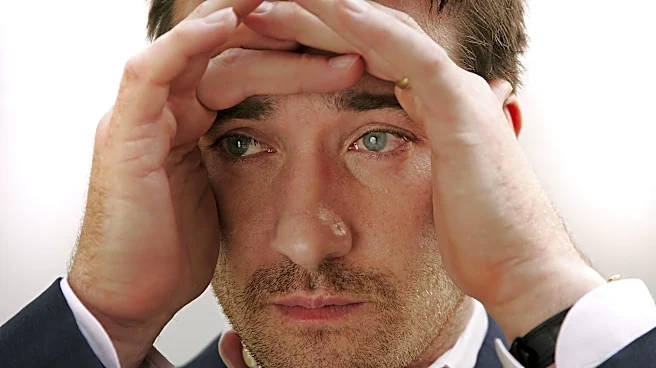
Actor and comedian Dax Shepard has admitted to feeling depressed due to a persistent public narrative portraying him as an 'abusive husband.' This sentiment was shared during an episode of his 'Armchair
Expert' podcast with guest Zosia Mamet, after co-host Monica Padman noted Shepard's depression. The controversy originated in October 2025 when Shepard's wife, Kristen Bell, posted an Instagram message for their 12th wedding anniversary. The post quoted Shepard saying, 'I would never kill you. A lot of men have killed their wives at a certain point. Even though I’m heavily incentivized to kill you, I never would.' This remark was widely criticized, especially as it coincided with Domestic Abuse Awareness Month. Shepard clarified that the comment was made while watching a true crime show, 'Dateline,' where spouses often kill their wealthy partners, and he intended it as a compliment to Bell, suggesting she was 'loaded.' Bell reportedly found the comment romantic. The narrative intensified after music icon Cher commented on Bell being the 'better half' of the marriage, and further speculation arose when Bell discussed Shepard's flirting habits on his podcast, which Shepard felt contributed to the perception of him as a 'terrible person.'
Why It's Important?
This situation highlights the significant impact of public perception and social media interpretation on individuals, particularly public figures. The controversy surrounding Dax Shepard's comments underscores how remarks, even those intended humorously or affectionately within a private context, can be misconstrued and amplified in the public sphere, leading to severe personal distress. For celebrities, managing their public image and navigating online scrutiny is a constant challenge, as their words and actions are often subjected to intense analysis and judgment. The incident also brings to light the broader societal sensitivity around issues like domestic abuse, where any perceived trivialization or inappropriate commentary can provoke strong negative reactions. This case serves as a reminder of the power of online narratives to shape reputations and mental well-being, demonstrating how quickly a public figure can become embroiled in controversy, regardless of their original intent. The ongoing discussion about Shepard's mental state due to this public backlash emphasizes the psychological toll that such scrutiny can take.
What's Next?
It is likely that Dax Shepard will continue to address the ongoing narrative on his 'Armchair Expert' podcast, using the platform to clarify his intentions and express his feelings regarding the public's perception. Given the nature of celebrity culture and social media, further discussions and interpretations of his past comments, as well as any future statements, are probable. Kristen Bell may also continue to be involved in these discussions, either directly or indirectly, as her initial Instagram post was the catalyst for the controversy. The public and media will likely monitor how Shepard and Bell navigate these discussions, particularly concerning their marriage and public image. There may be continued scrutiny of their interactions and statements as they attempt to manage the narrative. The situation could also prompt broader conversations within media circles about the responsibility of public figures in their communications and the role of media in interpreting and disseminating such content.
Beyond the Headlines
Beyond the immediate controversy, this incident touches upon several deeper implications regarding communication, public interpretation, and the mental health of public figures. It underscores the inherent challenges of humor and irony in a digital age where context can easily be lost, and statements are often taken literally or interpreted through a lens of heightened social awareness. The public's strong reaction to Shepard's anniversary comment, even with his explanation, reflects a societal intolerance for anything that might be perceived as trivializing domestic abuse, highlighting evolving cultural sensitivities. Furthermore, Shepard's admission of depression brings to the forefront the often-overlooked mental health struggles faced by celebrities under constant public scrutiny. It serves as a stark reminder that public figures are not immune to the emotional impact of widespread criticism and negative narratives, prompting a broader discussion about empathy and accountability in online discourse. This event could contribute to a more cautious approach by celebrities in their public and social media communications, emphasizing the need for careful consideration of how their words might be perceived by a diverse audience.