
What's Happening?
Lana Li, a dating consultant based in Brooklyn, New York, is employing artificial intelligence (AI) to assist men in improving their dating app photos. Operating under the Substack 'Love Me Like a Robot,'
Li describes herself as a 'digital stylist.' She uses AI to modify aspects such as outfits, hairstyles, and body language in clients' photos to present a more confident image. Additionally, Li utilizes FaceApp for subtle adjustments to facial expressions, aiming to make clients appear 'friendlier' by slightly lifting the corners of their mouths. While she extensively uses AI for enhancements, Li maintains a boundary, refusing requests that would misrepresent a client's true appearance, such as digitally placing a client's head on another person's body. This practice highlights the increasing integration of AI in personal presentation, particularly within the online dating landscape, where users are seeking to optimize their profiles to stand out.
Why It's Important?
The increasing use of AI in dating app photos, as demonstrated by Lana Li's services, signifies a growing trend in how individuals present themselves online. This development has significant implications for authenticity and trust in digital interactions. While AI tools can help users create more polished and appealing profiles, they also blur the lines between genuine representation and digital fabrication. This raises ethical questions about the extent to which individuals should manipulate their online personas. For dating app users, distinguishing between real and AI-enhanced photos is becoming more challenging, potentially leading to increased skepticism and wariness. The competitive nature of online dating, particularly for men who often receive fewer matches, drives the adoption of such technologies to gain an edge. This trend could reshape user expectations and the dynamics of initial attraction in the digital dating sphere, emphasizing visual perfection over unedited reality.
What's Next?
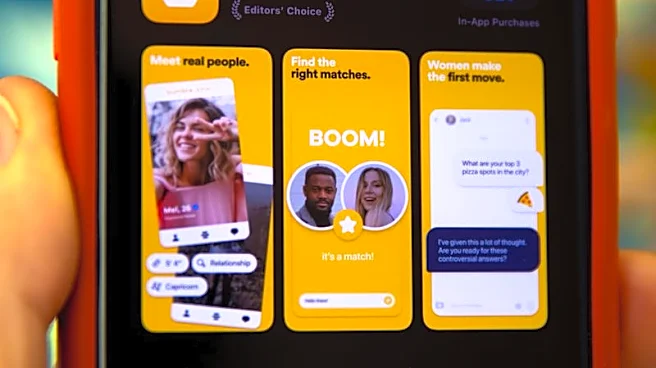
As AI technology continues to advance, the sophistication of photo editing and generation tools will likely increase, making it even harder to discern authentic images from AI-enhanced ones. Dating apps are already responding to this trend by implementing policies and tools to detect and manage AI-generated content. Hinge, for instance, emphasizes authenticity and uses automated tools and human reviewers to identify 'prohibited material,' while Bumble prohibits 'artificially generated photos or enhanced photos to deceive others.' These platforms will likely continue to refine their detection methods and policies to address the evolving capabilities of AI. Users may face stricter guidelines regarding AI usage, and there could be a push for greater transparency about whether a photo has been digitally altered. The ongoing tension between users' desire to present their best selves and platforms' commitment to authenticity will shape the future of online dating profiles.
Beyond the Headlines
The widespread adoption of AI for personal image enhancement, particularly in high-stakes social contexts like dating, touches upon deeper societal implications regarding self-perception and identity in the digital age. The pursuit of an 'ideal' online persona through AI raises questions about the psychological impact on individuals, potentially fostering unrealistic expectations and body image issues. If people consistently encounter highly curated or AI-generated images, it could lead to a collective shift in what is considered 'attractive' or 'normal,' further distancing digital interactions from real-world experiences. This trend also highlights the ethical responsibilities of technology developers and platform providers to balance innovation with user well-being and data integrity. The 'digital stylist' phenomenon, while offering a service, also underscores a broader cultural movement towards optimizing every aspect of one's online presence, potentially at the cost of genuine self-expression and vulnerability.