





What's Happening?
A new report by Break Free From Plastic, Facing Finance, and FairFin reveals that major financial institutions across Europe, the United States, and Asia-Pacific provided $219.4 billion in credit to four of the world's largest plastic-using consumer goods
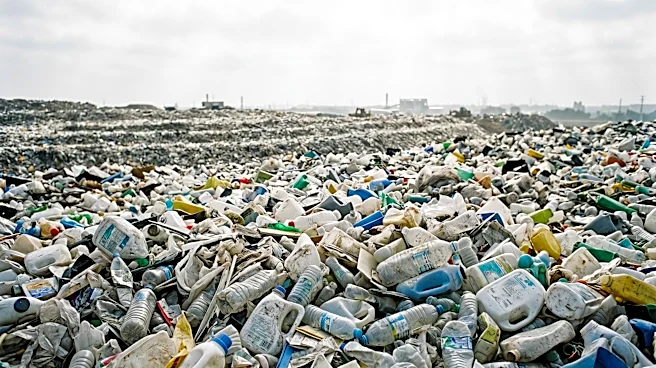
companies—Coca-Cola, PepsiCo, Nestlé, and Unilever—between 2019 and 2025. Additionally, these institutions held or managed $138 billion in shares in these companies as of May 31, 2025. U.S. financial institutions, led by Bank of America, Citigroup, and JPMorgan Chase, accounted for nearly half of this credit, providing $108.3 billion. European lenders contributed $95.4 billion. The report, titled 'Cashing In On Plastic,' examined financing from 61 global financial institutions, highlighting a significant disconnect between these institutions' public commitments to climate action and sustainability and their financial backing of companies heavily reliant on single-use plastics. The research indicates that plastic pollution is projected to more than double by 2040 without intervention, with environmental and health costs estimated to exceed $1.5 trillion annually.
Why It's Important?
This report underscores a critical issue in the global effort to combat plastic pollution and climate change: the financial sector's role in perpetuating the problem. The substantial financial backing provided by major institutions to top plastic polluters directly contradicts their stated environmental, social, and governance (ESG) commitments. This creates a systemic risk, as the true costs of plastic pollution, including corporate liabilities projected to reach $20 billion by 2030, are not adequately reflected in financial risk assessments. For U.S. industries and financial stakeholders, this highlights a potential for future regulatory scrutiny and reputational damage if financing practices do not align with sustainability goals. The continued investment in plastic-intensive business models also hinders the transition to a circular economy and sustainable packaging solutions, impacting public health and environmental quality globally. The report suggests that financial institutions must begin to treat plastic production and use as a material financial risk, which could lead to significant shifts in investment strategies and corporate accountability.
What's Next?
The report calls for financial institutions to assess plastic production and use as a material financial risk, set clear expectations and disclosure requirements for financed companies, and scale up financing for reuse, refill, and low-waste business models. It also urges them to strengthen internal policies to prevent plastic expansion from being financed through general corporate lending. In response to such findings, there may be increased pressure from advocacy groups, investors, and potentially regulators for financial institutions to align their lending and investment portfolios with their sustainability pledges. This could lead to new internal policies within banks and investment firms, potentially restricting financing for companies that do not demonstrate clear plans to reduce plastic use. Furthermore, the ongoing negotiations for a global plastics treaty could introduce new international frameworks that influence financial institutions' responsibilities and liabilities regarding plastic pollution, potentially leading to more stringent reporting and investment criteria.
Beyond the Headlines
The implications of this report extend beyond immediate financial disclosures and investment strategies. It raises fundamental questions about the integrity of ESG commitments made by financial institutions and the effectiveness of current sustainability frameworks. The 'hypocrisy' highlighted by the report suggests a deeper systemic issue where short-term financial gains may be prioritized over long-term environmental and social well-being. This could lead to increased public distrust in corporate sustainability claims and a demand for more robust, legally binding regulations rather than voluntary commitments. Ethically, the continued financing of plastic pollution, despite its known environmental and health impacts, challenges the social responsibility of financial institutions. Legally, the growing understanding of plastic's harm could lead to increased litigation against both polluters and their financial enablers, potentially reshaping corporate liability laws and financial regulations in the coming years. This development could also accelerate the shift towards more sustainable economic models, driven by both consumer demand and investor pressure for genuine environmental stewardship.