







What's Happening?
Alicia Garcia-Herrero, a senior fellow at Bruegel and chief economist for Asia-Pacific at Natixis, has stated that the world is entering a 'China shock 3.0' phase, which she believes could surpass previous waves. This new phase is anticipated to be driven
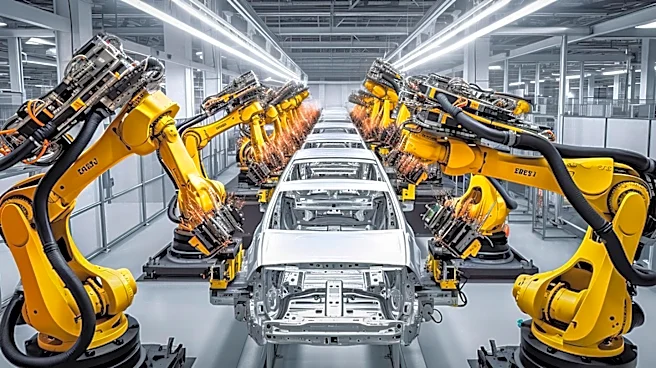
by China's exports in artificial intelligence hardware and software, biotechnology, and robotics. Garcia-Herrero shared these insights during a virtual panel hosted by the Washington-based Peterson Institute for International Economics (PIIE). She noted that China, while still a significant importer of advanced chips, is developing its own AI hardware and software for export, potentially bundled with data center and cloud services. The economist also highlighted the potential for China to export humanoid and industrial robots, suggesting that China's low energy costs could lead to the world's lowest computing costs, extending its competitiveness from industrial goods to services. This development follows previous 'China shocks' identified by U.S. economists, linking increased Chinese imports to U.S. manufacturing job losses and factory town decline after China joined the WTO in 2001, and a second wave involving more advanced manufacturing since around 2018.
Why It's Important?
The predicted 'China shock 3.0' carries significant implications for global trade and U.S. industries. If China becomes a dominant exporter in AI, biotech, and robotics, it could reshape global supply chains and competitive landscapes. U.S. technology and manufacturing sectors might face increased competition, potentially leading to job displacement or pressure on domestic industries to innovate and reduce costs. The discussion at PIIE also highlighted differing views on how the West should respond, with some arguing for inviting Chinese investment and others questioning its benefits due to concerns about technology transfer limitations and China's security rules. This divergence underscores the complex policy challenges facing the U.S. and its allies in navigating China's growing technological prowess. The potential for China to offer services with low computing costs could also impact the global digital economy, affecting cloud service providers and data centers worldwide.
What's Next?
The ongoing debate among experts and policymakers regarding how to address China's economic rise and its implications for global trade is expected to intensify. As China continues to develop and export advanced technologies, there will likely be increased scrutiny from the U.S. and its allies regarding trade practices, intellectual property, and national security. The U.S. and other economies have already signed a statement pledging action on structural excess capacity in sectors like electric vehicles, batteries, and chips, indicating a multilateral effort to pressure Beijing. Future discussions may focus on developing strategies that balance economic engagement with safeguarding national interests and promoting fair competition. The need for 'wise and courageous politicians' to find a way forward, as suggested by Yeling Tan of the University of Oxford and PIIE, indicates that diplomatic and policy efforts will be crucial in managing potential economic shifts and geopolitical tensions.
Beyond the Headlines
The concept of 'China shock 3.0' extends beyond immediate economic competition, touching upon deeper geopolitical and technological shifts. The potential for China to lead in AI, biotech, and robotics raises questions about future global technological leadership and the ethical implications of widespread AI and robotic integration. Concerns about data security and the control of critical technologies could become more pronounced, influencing international standards and regulations. The differing perspectives on engaging with China—whether through investment or containment—highlight a fundamental tension in international relations. This new phase could also accelerate the decoupling of technological ecosystems, with countries potentially developing separate standards and supply chains for advanced technologies, leading to a more fragmented global technological landscape. The long-term impact on innovation, global collaboration, and economic interdependence remains a critical area of consideration.