



What's Happening?
The Boston Red Sox are expected to explore trading an All-Star outfielder this winter, a move driven by a persistent 'outfield logjam' within the organization. According to Alex Speier of The Boston Globe, the team has a surplus of outfield talent, including
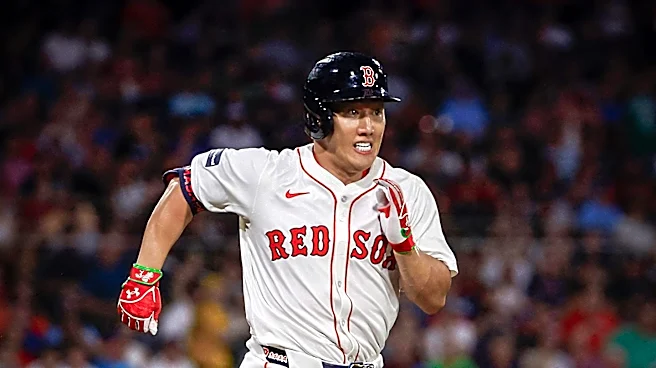
Roman Anthony, Wilyer Abreu, Ceddanne Rafaela, Jarren Duran, and Masataka Yoshida, along with other minor league prospects. This abundance makes it difficult to provide adequate playing time for all players. Jarren Duran, who has been a frequent subject of trade discussions for the past two years, is a primary candidate. Despite achieving a 20-20 season in 2026, his trade value has reportedly reached an 'all-time low' due to a dismal .207/.266/.361 batting line and increased chase and whiff rates. The Red Sox are also considering trading Masataka Yoshida.
Why It's Important?
This strategic decision by the Red Sox reflects a critical effort to rebalance their roster and address inefficiencies. The 'outfield logjam' not only creates challenges in player development and playing time allocation but also ties up significant financial resources. Trading an All-Star outfielder, even at a potentially lower value, could free up salary and roster spots, allowing the team to acquire players in positions of greater need, such as pitching or infield. This move is crucial for the Red Sox to build a more cohesive and competitive team, especially after a challenging 2026 season. The outcome of these trade explorations will significantly influence the team's direction and its ability to contend in future seasons, impacting both on-field performance and financial flexibility.
What's Next?
The Red Sox front office will actively engage in trade discussions this offseason, particularly regarding Jarren Duran and Masataka Yoshida. Despite Duran's diminished trade value, the team may opt to 'sell low' rather than continue to pay an 'eight-figure salary' for a player without a guaranteed everyday role, especially with two years of arbitration remaining. The organization will seek to maximize any return for these players, aiming to acquire assets that address other roster deficiencies. The resolution of these trade talks will be a key factor in shaping the Red Sox's roster for the 2027 season, potentially leading to significant changes in the team's composition and strategic approach.
Beyond the Headlines
The Red Sox's predicament with their outfield depth underscores the complex dynamics of roster management in professional baseball. The challenge of having too much talent in one area, while seemingly a good problem, can create difficult decisions regarding player development, team chemistry, and financial allocation. The willingness to trade an All-Star, even if it means accepting a lower return, highlights a pragmatic approach to team building, prioritizing overall roster balance and future competitiveness over individual player value. This situation also reflects the cyclical nature of sports, where even successful players can become trade chips as teams constantly adapt to evolving needs and market conditions, emphasizing the business aspect of professional sports beyond the game itself.