






What's Happening?
A recent study published in Nature Communications reports a breakthrough in solid-state lithium-sulfur batteries, demonstrating that pre-embedding iodine alongside sulfur within porous carbon significantly improves charging speed and extends battery life.
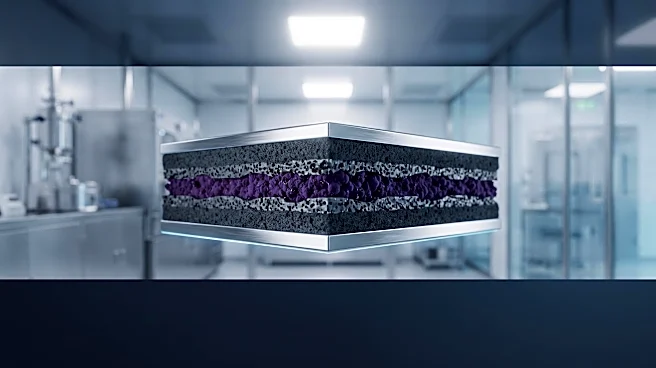
Researchers developed a pre-embedded solid-solid redox mediation (PE-SSRM) strategy, creating an amorphous nanocomposite of sulfur and iodine within mesoporous Ketjen black carbon. This innovative approach accelerates sulfur conversion through reversible iodine redox reactions, addressing key limitations of conventional solid-state lithium-sulfur batteries, such as slow sulfur reactions and poor contact between solid electrode components. The study found that the S8I2/KB electrode exhibited superior high-rate charging performance, delivering high specific capacities even at rapid charging rates (up to 24C). Furthermore, the electrode demonstrated exceptional long-term cycling stability, retaining a high percentage of its initial capacity after thousands of cycles, even at high active-material loadings. This work provides a materials-engineering route to reduce interfacial constraints in solid-state conversion electrodes.
Why It's Important?
This development holds significant promise for the future of energy storage in the U.S. and globally. Solid-state lithium-sulfur batteries offer several advantages over traditional lithium-ion batteries, including higher specific energy, enhanced thermal safety, and lower material costs. Overcoming the challenges of slow sulfur reactions and poor interfacial contact has been a major hurdle in their commercialization. The ability to achieve rapid charging and extended cycle life, as demonstrated by this research, makes these batteries more viable for a wide range of applications, from electric vehicles to grid-scale energy storage. For the U.S., this could translate into advancements in sustainable transportation, renewable energy integration, and a more secure energy infrastructure. Industries reliant on high-performance, safe, and cost-effective battery technology stand to gain significantly, potentially accelerating the transition to a cleaner energy economy and reducing dependence on critical raw materials used in current battery chemistries.
What's Next?
While the experiments remain laboratory demonstrations, the next steps involve further research to quantify iodine transport and its reaction kinetics with lithium sulfide and lithium polysulfides. Practical implementation will require addressing key cell-level engineering challenges, including improving negative-electrode energy density, enhancing lithium-metal–electrolyte interfacial stability, and increasing solid-electrolyte conductivity. The study indicates that the concept is not limited to thin, dilute cathodes, suggesting potential for high-loading applications. Future work will focus on translating these laboratory results into full-cell configurations that can meet commercial demands. If successful, this technology could lead to the development of next-generation batteries with superior performance characteristics, potentially impacting the automotive, electronics, and renewable energy sectors. Collaboration between academic research and industrial development will be crucial to overcome remaining hurdles and bring this promising technology to market.
Beyond the Headlines
This research delves into the fundamental chemistry and materials science of battery technology, highlighting the intricate interplay between material composition and electrochemical performance. The use of a 'pre-embedded solid-solid redox mediation' strategy represents a sophisticated approach to engineering interfaces at the nanoscale, a critical area for advancing energy storage. Beyond the immediate applications, this work contributes to a deeper understanding of conversion reactions in solid-state systems, which could inspire similar breakthroughs in other electrochemical devices. The long-term implications extend to reducing the environmental footprint of battery production and disposal, as sulfur is a more abundant and less toxic element than many materials currently used in batteries. This scientific advancement underscores the continuous innovation required to meet global energy demands sustainably and efficiently, pushing the boundaries of what is possible in materials science and electrochemistry.