



What's Happening?
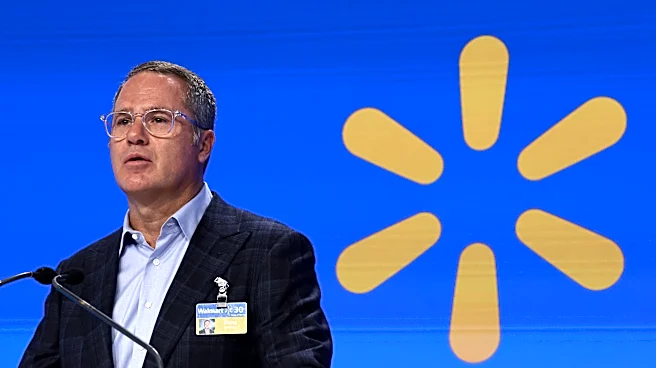
Walmart's share price experienced a 3% decline when it was announced that Doug McMillon, the CEO of 10 years, would be stepping down. This market reaction occurred despite John Furner, CEO of Walmart U.S., taking over in what appeared to be a smooth succession.
The event underscores the financial market's sensitivity to leadership transitions, even when internal candidates are promoted. A Harvard Business Review analysis further emphasizes this point, estimating that poorly managed CEO successions have wiped out $1 trillion in market value from the S&P 500 in a single year, while well-planned transitions could lead to 25% higher investor returns.
Why It's Important?
This incident highlights the critical importance of leadership succession planning for U.S. public companies and their investors. The immediate 3% drop in Walmart's share price, despite an internal and seemingly smooth transition, demonstrates that markets react not just to the fact of a change but also to the perceived uncertainty it introduces. For businesses, this means that robust, transparent, and well-communicated succession plans are not merely an internal HR function but a vital component of investor relations and market stability. Shareholders stand to lose billions from poorly executed transitions, while effective planning can significantly boost investor confidence and returns. This dynamic affects corporate governance, executive compensation, and long-term strategic planning across the U.S. economy.
What's Next?
The market's reaction to Walmart's CEO transition announcement will likely reinforce the need for U.S. companies to prioritize and refine their leadership succession strategies. Boards of directors may face increased pressure from shareholders to demonstrate clear, long-term plans for executive leadership, particularly for CEO roles. This could lead to more rigorous internal development programs, earlier identification of potential successors, and more transparent communication with investors about transition processes. Companies that fail to address these concerns risk not only stock price volatility but also potential challenges in attracting and retaining top talent, as a clear path for leadership can be a significant draw.
Beyond the Headlines
The market's immediate reaction to a CEO transition, even a seemingly smooth one, reveals a deeper psychological and trust-based dimension in financial markets. Investors often view a long-standing CEO as a symbol of stability, strategic direction, and institutional knowledge. The departure of such a figure, regardless of the successor's qualifications, can trigger anxieties about future performance, strategic shifts, or potential disruptions. This goes beyond mere financial metrics, touching upon the perceived 'soul' of a company. It underscores that leadership is not just about management but also about embodying the company's vision and maintaining investor confidence, highlighting the intangible value that a CEO brings to a public entity.