






What's Happening?
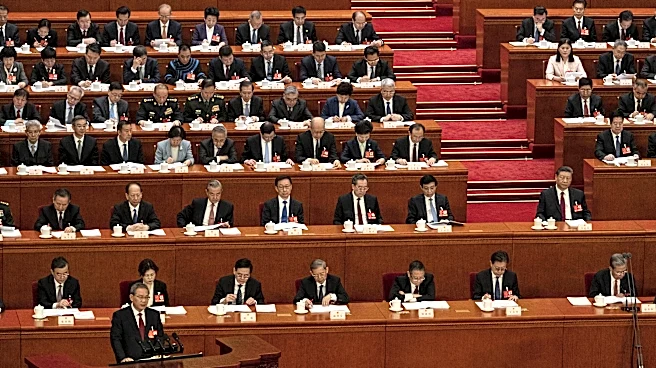
Chinese Premier Li Qiang chaired a cabinet meeting on Friday, advocating for a greater involvement of state-backed 'national team' investors to stabilize the country's stock market. This move, reported by the official Xinhua news agency, signals Beijing's
intent to intervene in a market that has been struggling near 16-month lows. The State Council executive meeting's statement highlighted that the sovereign wealth fund Central Huijin Investment will enhance its role as China's quasi-'stabilization fund' to provide sufficient liquidity during periods of market turmoil. The meeting also emphasized the critical importance of the capital market to overall economic development and committed to guiding long-term funds into the market while addressing imported risks. Following this news, China's share benchmark saw a 4% jump on Friday, marking its best performance in two years.
Why It's Important?
This development is significant as it represents a clear and public commitment from the Chinese government to actively support its capital markets, which have been impacted by global economic factors, geopolitical tensions, and a domestic economic slowdown. The explicit mention of the 'national team' in a State Council executive meeting press release for the first time underscores the seriousness of the government's intervention. By leveraging entities like Central Huijin, which Xinhua noted has 'plenty of firepower,' Beijing aims to restore investor confidence and prevent further market declines. A stable stock market is viewed as crucial for stabilizing expectations and supporting China's broader economy, as it links corporate financing with household wealth. This intervention could set a precedent for how major economies respond to market volatility, potentially influencing global financial strategies.
What's Next?
The immediate impact of this announcement has been a positive surge in China's stock market. Moving forward, market participants will closely monitor the actions of Central Huijin Investment and other state-backed entities to see how they deploy their resources to inject liquidity and support stock prices. The government's commitment to guiding long-term funds into the market suggests potential policy adjustments or incentives to attract institutional investors. Additionally, China plans to introduce new incremental policies for its capital markets, including measures to encourage listed companies to increase dividends and share buybacks. These steps are intended to further improve capital market stabilization and build a stronger 'breakwater' against external shocks, such as U.S. yield volatility, cross-border capital flows, and monetary policy shifts in other major economies.
Beyond the Headlines
The Chinese government's direct intervention in its stock market through state-backed investors highlights a distinct approach to economic management compared to more free-market economies. This strategy reflects a broader philosophy where the state plays a significant role in maintaining economic stability and guiding market outcomes. While such interventions can provide short-term stability and confidence, they also raise questions about market efficiency, transparency, and the potential for moral hazard. The emphasis on 'national team' investors could lead to a market environment where state influence is more pronounced, potentially affecting foreign investment decisions and the overall perception of China's capital markets as a level playing field. This approach also underscores the government's concern over the interconnectedness of its capital markets with global economic trends and its determination to mitigate 'imported risks.'