



What's Happening?
Ten second-year industrial design students from the University of Cincinnati's School of Design, Architecture, Art, and Planning (DAAP) have successfully developed a new sensor mounting system for Sensory Robotics. This project, part of the Experiential
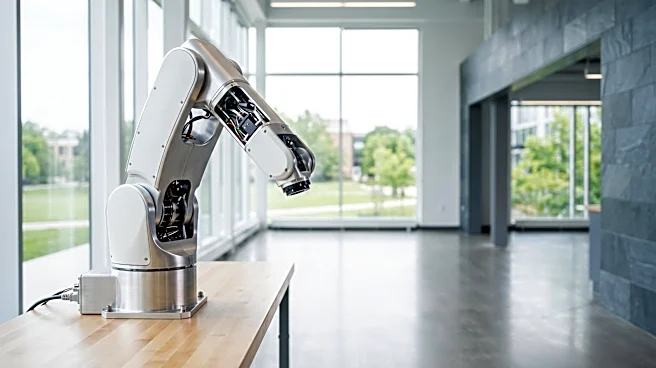
Explorations Program, focused on enhancing the safety system for the company's future robotic arm technology, the SR-2. The students were tasked with designing an outward sensing approach to bring sensors closer to the robot, aiming to reduce the need for extensive framework while maintaining human safety coverage. Owen Eklund and Elliot Toland, co-project managers, led the effort. Toland focused on the physical bracket and ring design, while Eklund utilized computer-aided design (CAD) to model sensor placement and coverage, ultimately arriving at a six-sensor concept to minimize blind spots around the robotic arm. This initiative allowed students to apply their 3D modeling, CAD, and prototyping skills in a real-world commercial product development scenario.
Why It's Important?
This collaboration between DAAP students and Sensory Robotics highlights the critical role of industrial design in advancing robotics and workplace safety. By developing an innovative sensor mounting system, the students are contributing to the evolution of industrial robots that can operate safely alongside humans without physical barriers, a significant step forward from traditional caged systems. This advancement has the potential to streamline manufacturing processes, improve efficiency, and create more flexible work environments across various U.S. industries. For the students, the project provided invaluable hands-on experience, bridging academic learning with practical industry demands. It also demonstrates the importance of interdisciplinary approaches, combining design principles with engineering challenges, to solve complex problems in the rapidly growing field of automation and robotics. Companies like Sensory Robotics stand to gain from fresh perspectives and innovative solutions, while the workforce benefits from safer and more integrated human-robot collaboration.
What's Next?
The successful development of the six-sensor concept by the DAAP students marks a significant step for Sensory Robotics' future SR-2 system. The company will likely proceed with further testing and refinement of this design, integrating the students' work into their next generation of robotic arm technology. This could lead to the commercialization of the SR-2 system with enhanced safety features, potentially setting new industry standards for human-robot interaction in industrial settings. For the participating students, this experience will serve as a strong foundation for their careers, potentially leading to opportunities within the robotics or industrial design sectors. The Experiential Explorations Program is expected to continue fostering such collaborations, providing ongoing opportunities for students to contribute to real-world technological advancements and for companies to benefit from academic innovation.
Beyond the Headlines
The project underscores a broader trend in industrial design education: the increasing emphasis on practical, problem-solving applications that directly address societal and industrial needs. Beyond the technical aspects, this initiative touches upon the ethical considerations of integrating advanced robotics into human workspaces. By focusing on safety and seamless human-robot interaction, the design addresses concerns about job displacement and the potential for accidents, fostering greater acceptance and trust in automation. This type of collaborative model between academia and industry is crucial for developing a skilled workforce capable of navigating the complexities of future technologies. It also highlights how design thinking, often perceived as purely aesthetic, is fundamental to creating functional, safe, and user-friendly solutions in highly technical fields, ultimately shaping the future of work and industrial environments.