







What's Happening?
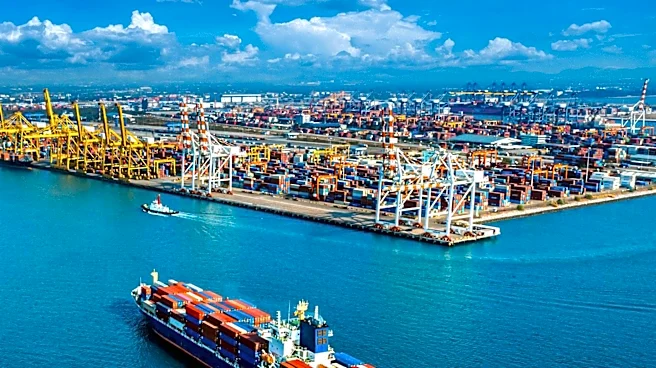
The Government of Canada has officially listed Roberts Bank Terminal 2 as a project of national interest. This designation aims to strengthen Canada's economic sovereignty and diversify its trade by expanding capacity at the Port of Vancouver, the country's
largest port and primary gateway to Indo-Pacific markets. The project, a $5.9 billion investment, is expected to add 2.4 million containers of annual capacity, increasing the Port of Vancouver's container capacity by approximately 50 percent. This initiative is crucial for Canada to achieve its goal of doubling non-U.S. exports by 2035. The listing provides immediate regulatory certainty, accelerating the project's commercial operations by up to four years, from 2039 to 2035, and aims for a Final Investment Decision (FID) by mid-2027.
Why It's Important?
This decision is significant for Canada's economic future, particularly in an increasingly uncertain global landscape marked by geopolitical tensions and supply chain pressures. By expanding port capacity, Canada seeks to reduce its reliance on a single trading partner and enhance its resilience to global shocks. The project is projected to contribute approximately $3 billion annually to Canada's GDP, generate around $631 million annually in tax revenues, and support approximately 17,000 jobs across the supply chain. Without this new capacity, Canadians could face an estimated $800 million to $900 million annually in additional shipping costs starting as early as 2031. The investment also aims to lower costs for Canadians by saving roughly $1 billion annually in shipping-related expenses through improvements in rail networks, logistics facilities, and port modernization.
What's Next?
With the designation as a project of national interest, Roberts Bank Terminal 2 is now on a viable path toward a Final Investment Decision (FID) by mid-2027. The Vancouver Fraser Port Authority (VFPA), as the project proponent, will lead its execution in collaboration with the Major Projects Office and other federal partners. The project will proceed while maintaining rigorous environmental safeguards and engaging in meaningful consultation with Indigenous communities, as outlined in 27 Mutual Benefit Agreements. The Government of Canada has also committed significant investments, nearly $2 billion, to protect oceans and marine life, including specific measures for Pacific salmon and Southern Resident Killer Whales. The accelerated timeline means commercial operations are now anticipated to begin by 2035, four years earlier than previously projected.
Beyond the Headlines
This strategic infrastructure investment reflects a broader shift in Canada's trade policy, emphasizing economic sovereignty and diversification away from traditional markets. It highlights the critical role of modern port infrastructure in global competitiveness and supply chain resilience. The project's commitment to environmental protections and Indigenous engagement sets a precedent for large-scale developments, balancing economic growth with social and ecological responsibilities. The focus on reducing shipping costs and improving efficiency for businesses and consumers underscores the government's efforts to mitigate inflationary pressures and enhance the overall quality of life for Canadians. This initiative could serve as a model for other nations looking to strengthen their trade infrastructure while addressing environmental and social considerations.