




What's Happening?
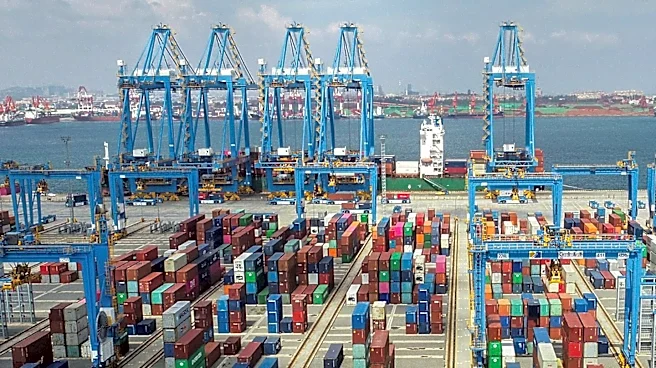
Global trade is experiencing a surprisingly strong performance this year, but this growth is accompanied by a rising tide of empty containers, which have historically presented problems for shipping lines and ports. According to Rico Luman, a senior economist
for Dutch investment bank ING, container volumes are proving more resilient than anticipated despite various headwinds, but this resilience comes with a significant increase in empty containers. This issue is particularly driven by exports from China, leading to a growing imbalance in East-West trade. This imbalance results in a higher volume of empty containers on the backhaul journeys, for which shipping liners do not generate revenue. The growth in trade is broad-based, with a notable surge in components related to electrification, such as those used in data centers and electric vehicles.
Why It's Important?
The proliferation of empty containers poses a significant challenge to the efficiency and profitability of the U.S. and global shipping industries. While robust trade growth is generally positive for the economy, the cost and logistical complexities associated with managing and repositioning empty containers can erode profit margins for shipping lines and increase operational expenses for ports. This issue can lead to inefficiencies in the supply chain, potentially causing delays and higher freight costs for businesses that rely on international trade. The imbalance in East-West trade, where more containers are shipped out of China than are returned full, highlights structural challenges in global logistics networks. This situation can also impact environmental sustainability efforts, as the movement of empty containers contributes to fuel consumption and emissions without directly facilitating trade. Ultimately, the effective management of empty containers is crucial for maintaining the momentum of global trade growth and ensuring the smooth flow of goods to consumers and industries worldwide.
What's Next?
Addressing the issue of empty containers will likely require innovative solutions from shipping lines, ports, and logistics providers. This could include enhanced data analytics and forecasting to better predict and manage container flows, as well as collaborative efforts to optimize repositioning strategies. Investment in new technologies, such as smart containers that provide real-time location and status updates, could also play a role in improving efficiency. Furthermore, there may be a push for greater international cooperation to standardize processes and share resources for container management. The industry might also explore alternative uses or recycling programs for surplus containers in certain regions to mitigate their environmental and logistical impact. The ongoing growth in trade, particularly in electrification components, suggests that the demand for container shipping will remain high, making the efficient handling of both full and empty containers a critical factor for future trade stability.
Beyond the Headlines
The challenge of empty containers extends beyond mere logistics, touching upon the fundamental economics of globalized production and consumption. It underscores the inherent inefficiencies in a system designed for one-way flows of goods, particularly from major manufacturing hubs like China. This situation highlights the environmental footprint of global trade, as the movement of empty vessels and containers contributes to carbon emissions without direct economic value. Philosophically, it prompts a re-evaluation of the 'just-in-time' inventory models and the broader implications of a highly interconnected, yet often imbalanced, global supply chain. The issue also reflects geopolitical and economic power dynamics, where trade imbalances manifest physically in the form of container surpluses and deficits. Long-term solutions might involve a more regionalized approach to manufacturing or the development of more circular economic models that reduce the need for extensive backhauls of empty containers, thereby fostering greater sustainability and resilience in global trade.