




What's Happening?
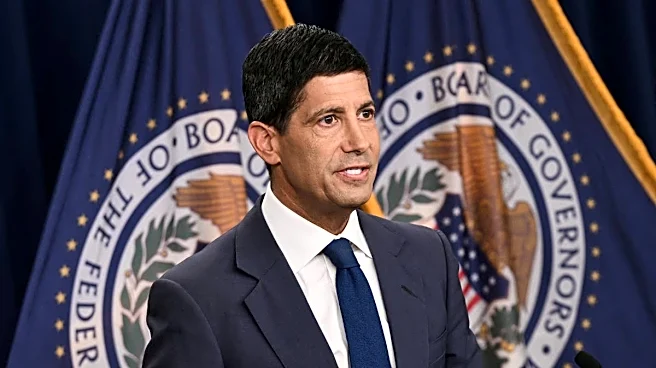
The Federal Reserve has announced its decision to maintain the interest rate paid on reserve balances at 3.65 percent, effective July 30, 2026. This decision follows the Federal Open Market Committee's (FOMC) recent statement on monetary policy. The FOMC has directed
the Open Market Desk at the Federal Reserve Bank of New York to undertake open market operations to keep the federal funds rate within a target range of 3-1/2 to 3-3/4 percent. Additionally, the FOMC has set the rate for standing overnight repurchase agreement operations at 3.75 percent and the rate for standing overnight reverse repurchase agreement operations at 3.5 percent, with a per-counterparty limit of $160 billion per day. The Federal Reserve will also continue to roll over principal payments from its holdings of Treasury securities and reinvest principal payments from agency securities into Treasury bills.
Why It's Important?
The Federal Reserve's decision to maintain the current interest rate reflects its ongoing efforts to stabilize the U.S. economy amid persistent inflation and global uncertainties. By keeping the interest rate steady, the Federal Reserve aims to support economic growth while managing inflationary pressures. This decision is crucial for financial markets, as it provides a predictable environment for investors and businesses. The maintenance of the interest rate also signals the Federal Reserve's cautious approach in navigating the complex economic landscape, balancing the need for economic growth with the risk of inflation. Stakeholders such as banks, businesses, and consumers are directly impacted by these monetary policy decisions, as they influence borrowing costs, investment strategies, and consumer spending.
What's Next?
The Federal Reserve will continue to monitor economic indicators and global developments to assess the need for future adjustments in monetary policy. The FOMC's decisions will likely be influenced by upcoming economic data, including employment figures, inflation rates, and global economic conditions. Market participants will be closely watching for any signals from the Federal Reserve regarding potential changes in interest rates or other monetary policy tools. The Federal Reserve's ongoing communication and transparency will be key in managing market expectations and ensuring economic stability.