





What's Happening?
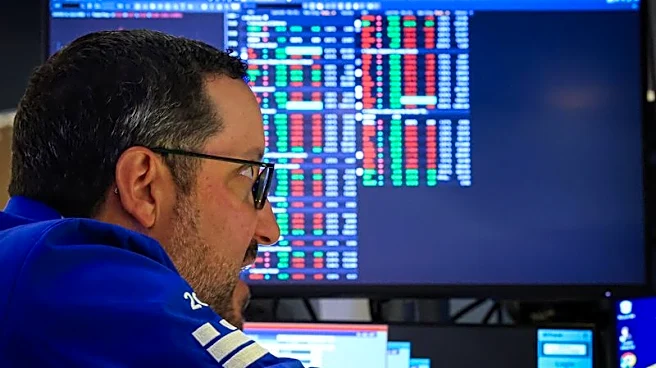
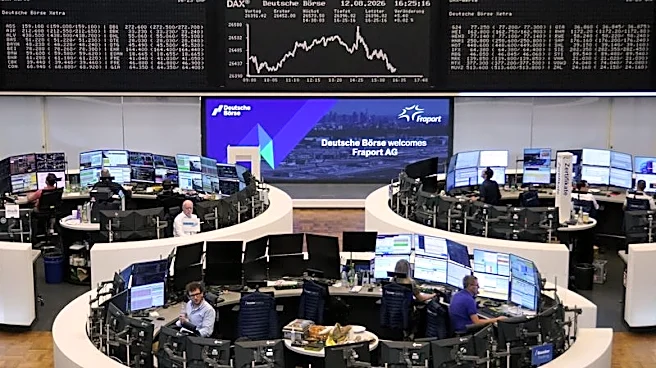
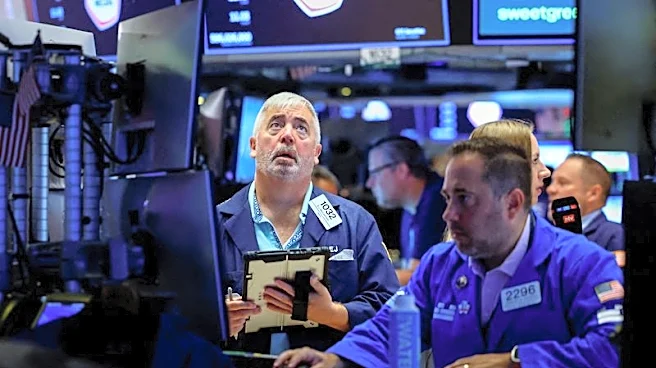
Economists at the European Central Bank (ECB) are cautioning that the current surge in U.S. and European stock markets, fueled by the artificial intelligence (AI) boom, is likely to face a significant correction. In a recent blog post, they drew parallels
between the present AI-driven rally and historical technological revolutions such as the 19th-century railway boom, the expansion of electricity and radio in the 1920s, and the internet's rise in the 1990s. The economists suggest two primary scenarios for a correction: either 'overconfident, overoptimistic investors' are pushing prices beyond their fundamental worth, leading to a crash when enthusiasm wanes, or a fall in prices is to be expected even if current valuations accurately reflect AI's potential to reshape the global economy and boost corporate profits. They emphasize that historical patterns indicate a boom-bust cycle in such periods of technological transition.
Why It's Important?
This warning from ECB economists carries significant implications for the U.S. financial markets and economy. The U.S. stock market, particularly the technology sector, has been a major beneficiary of the AI investment wave, with many companies reaching record valuations. A market correction, as predicted, could lead to substantial losses for investors, impact retirement savings, and potentially trigger broader economic instability. The economists highlight that European investors are highly exposed to such a downturn due to the dominance of 'Mag 7' stocks (referring to major U.S. tech companies) in index funds. A downturn could also affect corporate investment and consumer spending, potentially slowing economic growth. The historical comparisons suggest that even if AI's long-term potential is real, the short-to-medium term market dynamics could be volatile and challenging for investors.
What's Next?
While the exact timing of a market correction is inherently unpredictable, the ECB economists' warning suggests that investors should prepare for increased volatility and potential price adjustments in the near future. The analysis indicates that as AI adoption spreads, uncertainty could become economy-wide, leading investors to demand higher risk premia, which would eventually drive stock prices down. This could prompt a re-evaluation of investment strategies, with a potential shift towards more conservative assets or sectors. Regulatory bodies and central banks, including the Federal Reserve, may closely monitor market developments and investor sentiment to mitigate potential systemic risks. Companies heavily invested in AI may face increased scrutiny regarding their valuations and long-term profitability, potentially influencing future funding and expansion plans.
Beyond the Headlines
The ECB economists' analysis delves deeper than immediate market fluctuations, touching upon the psychological and systemic aspects of technological revolutions. The concept of 'overconfident, overoptimistic investors' driving valuations beyond fundamental worth highlights the role of human behavior in market cycles. This phenomenon, often seen in speculative bubbles, suggests that the current AI enthusiasm might be partly detached from realistic profit projections. Furthermore, the warning about economy-wide uncertainty as technology adoption spreads implies that the impact of AI is not confined to the tech sector but could ripple through all industries. This could lead to a redefinition of economic risk, where the success or failure of key technological advancements becomes pivotal for the entire economy, potentially necessitating new approaches to economic policy and risk management.