





What's Happening?
OpenAI and Oracle are key partners in the Stargate UAE AI campus, a significant artificial intelligence infrastructure project located in Abu Dhabi. This campus, which is nine times the size of Monaco and covers 19.2 km², is planned for 5 GW of power.
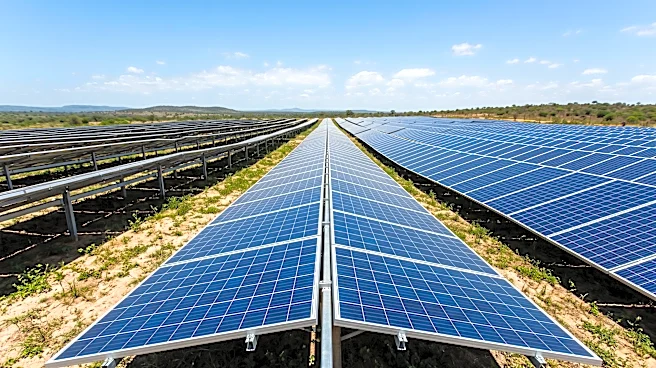
The first block, Stargate UAE, is a 1 GW cluster and represents OpenAI's first Stargate outside the U.S. The project is led by G42, with its data center company Khazna Data Centers building the facility. NVIDIA is supplying Grace Blackwell GB300 systems, while Cisco provides network and security infrastructure. SoftBank is also a partner. The campus is supported by a diverse power supply, including 5.6 GW of nuclear power from Barakah, 5.2 GW of solar power with 19 GWh of batteries from Masdar and EWEC, and a 1 GW gas plant from TAQA. The Stargate UAE project is funded jointly by the UAE and American entities, with the AI minister estimating its value at over $30 billion. MGX closed a $49 billion fund and holds a stake in Khazna, while Microsoft has invested $1.5 billion in G42 in 2024 and plans to invest $15.2 billion in the UAE through 2029. The UAE has become the first country to enable ChatGPT nationwide through OpenAI's deal, and ADNOC Group is deploying OpenAI Frontier on G42's infrastructure.
Why It's Important?
This collaboration signifies a major expansion of U.S. technology companies' global footprint in artificial intelligence infrastructure, particularly in the Middle East. The Stargate UAE campus, with its massive scale and advanced technology, positions the UAE as a critical hub for AI development and deployment, potentially influencing regional technological leadership. For U.S. companies like OpenAI, Oracle, NVIDIA, Cisco, and Microsoft, this project represents significant market penetration and a strategic move to leverage international partnerships for AI advancement. The substantial investments from both UAE and American sources highlight the growing economic interdependence in the tech sector and the global race for AI dominance. The deployment of OpenAI's technologies, such as ChatGPT nationwide and OpenAI Frontier for ADNOC, demonstrates the practical applications and economic benefits of such large-scale AI infrastructure, potentially setting a precedent for other nations and industries. The project also underscores the U.S.'s strategic decision to move the UAE into its group of closest partners, allowing G42 and Core42 to acquire advanced chips without per-shipment licenses, which could streamline technological exchange and foster deeper economic ties.
What's Next?
The Stargate UAE campus is expected to continue its phased development, with the first 200 MW already in two 100 MW buildings. The ongoing arrival of chips, including those from Microsoft and Washington's clearance for G42 to acquire up to 35,000 GB300s, indicates a rapid scaling of operations. The full operationalization of the 1 GW cluster and subsequent expansion towards the planned 5 GW capacity will be a key focus. Further integration of OpenAI's services across various sectors in the UAE, building on the nationwide ChatGPT enablement and ADNOC's deployment of OpenAI Frontier, is anticipated. The success of this project could encourage similar multinational AI infrastructure initiatives in other regions, potentially leading to a more interconnected global AI ecosystem. The long-term impact on the UAE's economy and its role as a global AI leader will be closely watched, as will the continued collaboration and investment from U.S. tech giants.
Beyond the Headlines
The Stargate UAE project extends beyond mere technological advancement; it represents a significant geopolitical and economic alignment. The U.S.'s decision to facilitate advanced chip access for the UAE through G42 and Core42 suggests a strategic effort to strengthen alliances and counter potential technological rivals. This move could reshape global supply chains for AI hardware and software, creating new dependencies and opportunities. Ethically, the widespread deployment of AI, particularly in a nation with a high AI adoption rate like the UAE (73.3% of working-age people), raises questions about data privacy, algorithmic bias, and the societal impact of AI on employment and daily life. The project's reliance on diverse energy sources, including nuclear, solar, and gas, also highlights the complex interplay between technological growth and sustainable energy solutions, setting a precedent for how future large-scale data centers might address their immense power demands. The campus's strategic location, serving nearly half the world's population within 3,200 km of Abu Dhabi, positions it as a critical infrastructure for global AI services, potentially influencing cultural and economic development across a vast region.