




What's Happening?
General Atomics Aeronautical Systems, Inc. (GA-ASI) has introduced a new uncrewed aircraft system (UAS) named 'Wildfire.' This clean-sheet design aims to maximize investments in large uncrewed aircraft by incorporating lessons from decades of global UAS operations.
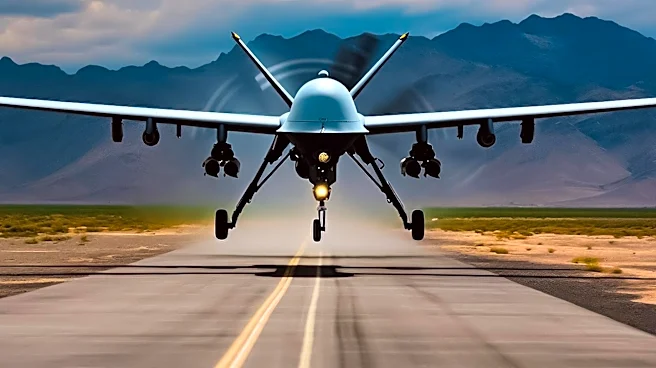
Wildfire merges features of GA-ASI's existing UAS with lower-cost components, tailored capabilities, and enhanced modularity. For defense customers, Wildfire is designed for rapid deployment in large numbers, enabling kinetic battlefield roles and increasing mass in combat scenarios that would otherwise be cost-prohibitive. In non-combat applications, its increased payload capacity and stronger hardpoints offer new possibilities for heavy cargo delivery and other commercial activities. GA-ASI President David R. Alexander stated that Wildfire balances high capability with flexibility and scalability, focusing on core intelligence, surveillance, and reconnaissance (ISR), strike, and similar roles. The aircraft is highly autonomous and designed for collaborative operations, leveraging FQ-42A systems. GA-ASI has proposed Wildfire for the U.S. Air Force’s Massed Modular Aircraft (MMA) competition within the Defense Innovation Unit (DIU), aiming to provide an alternative to the MQ-9A Reaper.
Why It's Important?
The introduction of the Wildfire UAS by GA-ASI signifies a strategic shift in the development and deployment of uncrewed aircraft, particularly for U.S. defense and commercial sectors. By focusing on lower-cost components and modularity, Wildfire could enable the U.S. military to field a greater number of uncrewed assets, enhancing its operational capacity and potentially altering the dynamics of future conflicts. This approach addresses the need for 'attrition-tolerant' systems that can be deployed in high-risk environments without the prohibitive costs associated with more complex platforms. For the U.S. Air Force, Wildfire's proposal for the MMA competition suggests a move towards more scalable and cost-effective alternatives to existing systems like the MQ-9A Reaper. This could lead to significant cost savings in defense procurement while maintaining or even expanding capabilities in ISR and strike missions. Commercially, the increased payload capacity opens new avenues for heavy cargo delivery, potentially revolutionizing logistics and supply chain operations in various industries. The emphasis on autonomy and collaborative operations also points to a future where uncrewed systems work in concert, increasing efficiency and effectiveness across diverse applications.
What's Next?
GA-ASI has proposed Wildfire for the U.S. Air Force’s Massed Modular Aircraft (MMA) competition, which seeks an alternative to the MQ-9A Reaper. Wildfire reportedly meets or surpasses all requirements of this request, including an impressive ferry range exceeding 8,000 nautical miles and the capacity to carry two Long-Range Anti-Ship Missiles or four Joint Strike Missiles simultaneously. The company claims Wildfire can be delivered years earlier than the DIU's FY2031 timeline, producing more than twice as many aircraft in the same period due to GA-ASI's existing manufacturing infrastructure and supplier network. This suggests that if selected, Wildfire could rapidly augment the U.S. military's uncrewed aircraft fleet. The aircraft's advanced autonomy and proliferated low-earth orbit satellite controls, already proven on other GA-ASI aircraft, indicate a readiness for immediate integration into networked, collaborative combat operations. The next steps will involve the evaluation of Wildfire by the Defense Innovation Unit and the U.S. Air Force, potentially leading to procurement contracts and the eventual deployment of these systems in both military and commercial capacities.
Beyond the Headlines
The development of Wildfire represents a broader trend in defense technology towards 'massed' and 'attrition-tolerant' systems, which could have profound implications for military strategy and procurement. The concept of fielding a large number of lower-cost, highly autonomous uncrewed aircraft challenges the traditional reliance on a smaller fleet of expensive, multi-role platforms. This shift could democratize access to advanced aerial capabilities, potentially influencing the balance of power in future conflicts. Ethically, the increased autonomy and potential for 'kinetic battlefield roles' raise questions about the decision-making processes of AI-driven systems in combat and the accountability for their actions. Legally, the deployment of such systems in large numbers could necessitate new international frameworks for regulating autonomous weapons. Culturally, the widespread adoption of highly autonomous uncrewed aircraft could reshape public perception of warfare and the role of human operators. Furthermore, the commercial applications, particularly in heavy cargo delivery, could trigger significant economic shifts, impacting traditional logistics industries and creating new markets for specialized uncrewed services. The emphasis on rapid production and early delivery also highlights the growing importance of industrial capacity and supply chain resilience in national security.