
What's Happening?
The World Bank Group is increasing access to longer-term Sri Lankan rupee financing to help local businesses mitigate foreign exchange risks and stimulate new private investment in renewable energy and infrastructure.
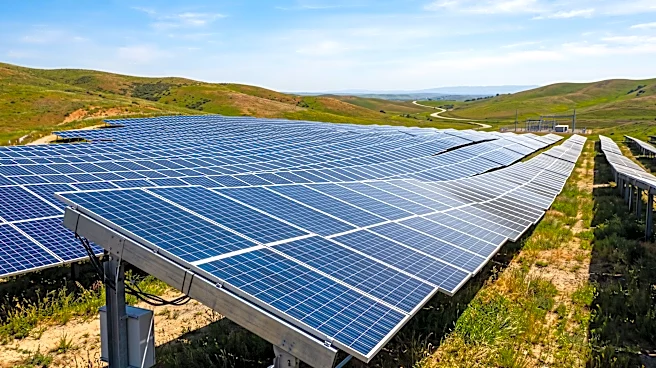
This initiative marks a significant development as the World Bank Group Treasury has arranged a six-year Sri Lankan rupee borrowing line between the International Finance Corporation (IFC), a private sector-focused member of the World Bank Group, and HSBC Sri Lanka. This fixed-rate facility, equivalent to US$5 million, is IFC's inaugural borrowing line in Sri Lanka. The funds are already being utilized to mobilize longer-term financing for renewable energy projects in the country. This includes IFC's US$10 million, 10-year rupee-denominated loan to a major Sri Lankan renewable energy company, representing IFC's longest-tenor rupee loan and its first rupee-denominated infrastructure loan in Sri Lanka since its recent economic crisis. By enabling local currency borrowing, the IFC aims to allow businesses to borrow in the currency they earn, thereby reducing their exposure to exchange-rate fluctuations.
Why It's Important?
This expansion of local currency financing is crucial for Sri Lankan businesses, particularly those in the renewable energy and infrastructure sectors. By reducing foreign exchange risk, companies can undertake long-term investments with greater financial stability, fostering growth and job creation. The initiative addresses a critical need in emerging markets where access to long-term local currency financing is often limited. For the World Bank Group, this transaction represents an expansion of its financing solutions in Asia, demonstrating a commitment to channeling private investment into sectors vital for economic development. The partnership with HSBC Sri Lanka also highlights the potential for collaboration between multilateral development institutions and private banks to support sustainable development goals. This model, building on similar facilities established in Kenya and South Africa, could serve as a blueprint for other emerging economies seeking to de-risk private sector investments and promote local economic resilience.
What's Next?
Building on this initial facility, the World Bank Group intends to further expand long-term local currency financing in Sri Lanka to bolster private investment and economic growth. This first borrowing line in Asia is expected to pave the way for more extensive financial solutions in emerging markets, encouraging private capital flow into critical sectors. The ongoing partnership between HSBC and the World Bank Group, including HSBC's participation in the Private Sector Investment Lab, suggests continued efforts to identify new avenues for public-private collaboration and mobilize private capital for sustainable development. Future developments may include the establishment of similar local currency borrowing lines in other Asian countries, as the World Bank Group seeks to replicate the success of this model to support businesses in managing foreign exchange risks and fostering long-term investment across the region.
Beyond the Headlines
This initiative underscores a broader strategic shift by multilateral development banks to optimize their financial tools and partnerships to address the unique challenges faced by emerging economies. The focus on local currency financing reflects a recognition that currency volatility can be a significant impediment to long-term investment and economic stability. By mitigating this risk, the World Bank Group is not only facilitating individual projects but also strengthening the overall financial ecosystem in Sri Lanka. This approach could lead to greater financial independence for developing nations, reducing their reliance on foreign currency loans and the associated vulnerabilities. Furthermore, the emphasis on renewable energy and infrastructure aligns with global sustainable development goals, demonstrating how financial innovation can be leveraged to support environmental objectives while fostering economic resilience.