







What's Happening?
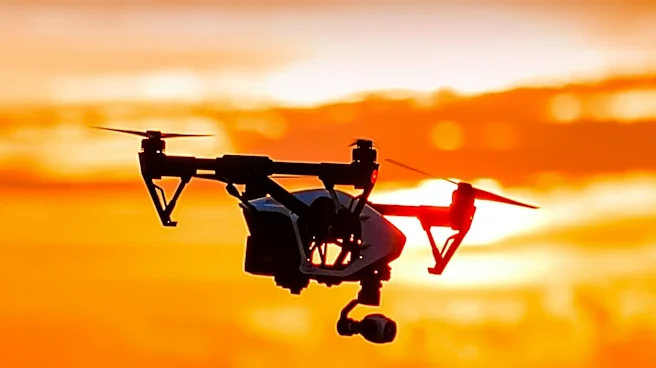
Drone stocks, including Unusual Machines, Red Cat Holdings, Ondas Holdings, Kratos Defense, and AeroVironment, experienced significant declines on Monday, with Unusual Machines dropping 9%, Red Cat falling 7%, and Ondas declining 5%. This widespread sell-off
occurred without any specific company news, contract awards, earnings releases, regulatory actions, or analyst rating changes. The REX Drone ETF (DRNZ) also fell by 4%, while the broader Invesco QQQ Trust (QQQ) saw only a shallow drop of 0.7%. This indicates that the drone sector's decline is a 'beta event,' where higher-volatility names are disproportionately affected by a modest weakness in the broader market, rather than a market-wide selloff driven by fundamental business developments.
Why It's Important?
This synchronized decline in drone stocks, absent any specific negative news, highlights a broader shift in investor sentiment and risk appetite within the technology and defense sectors. It suggests that investors are reducing exposure to higher-volatility assets, even those with strong year-to-date performance like Unusual Machines, which was up 115% before today's drop. This 'risk-off' behavior can impact the ability of smaller, high-growth companies in the drone industry to raise capital or maintain their valuations. For the U.S. defense complex, particularly its high-beta corners, such movements indicate that market positioning and investor psychology can outweigh fundamental business developments in the short term. This trend could lead to increased scrutiny of valuations and a more cautious approach to speculative investments in emerging technology sectors, affecting both established players and innovative startups.
What's Next?
Investors in the drone sector will be closely watching for signs of stabilization or a deeper market correction. The current situation suggests that the market is prioritizing risk reduction, and this trend could continue if broader market weakness persists. Companies in this sector may face increased pressure to demonstrate clear paths to profitability and sustainable growth to reassure investors. Any future company announcements, such as new contracts or positive earnings reports, will be crucial in potentially reversing the current downward trend. However, given that the decline is driven by a fading risk appetite rather than specific company news, a broader shift in market sentiment towards riskier assets might be necessary for a sustained recovery in drone stock valuations. Investors are advised to re-evaluate their position sizing in these high-beta names.
Beyond the Headlines
The uniform decline across diverse drone companies, despite varying year-to-date performances and business profiles, underscores a significant market dynamic: the impact of 'beta' on stock performance. Beta, a measure of a stock's volatility in relation to the overall market, means that high-beta stocks tend to amplify market movements. In a 'risk-off' environment, these stocks experience larger declines. This event highlights the importance of understanding market psychology and positioning, as opposed to solely focusing on company fundamentals, especially in speculative or high-growth sectors. It also raises questions about the sustainability of valuations for companies that have seen rapid growth without corresponding profitability. The long-term implication could be a more disciplined approach to investing in emerging technologies, where market participants demand a clearer balance between growth potential and financial stability, potentially leading to a re-evaluation of how risk is priced in the tech and defense industries.