




What's Happening?
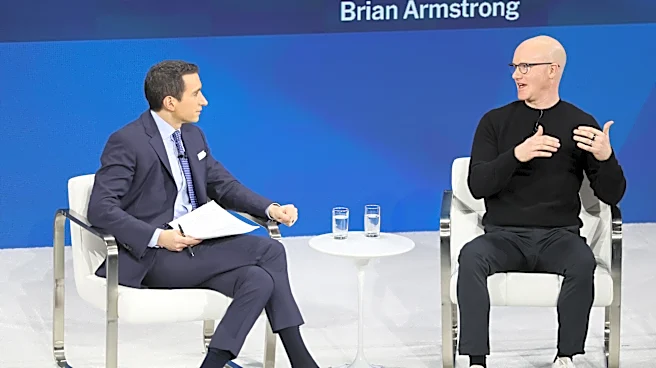
Coinbase CEO Brian Armstrong has stated that Bitcoin remains a crucial asset for investors anticipating higher inflation, suggesting that capital historically flows back into cryptocurrencies after significant stock market listings. In a recent post on X,
Armstrong explained that investors often sell Bitcoin to participate in large initial public offerings (IPOs) but tend to return to the crypto market once these offerings conclude. This perspective comes as Bitcoin has experienced a notable decline in November, trading near $60,090 on Wednesday, down from approximately $80,000 in late October. The crypto market's current weakness is also linked by Ripple CEO Brad Garlinghouse to investors liquidating assets to raise cash for Anthropic's recent listing, indicating a potential recovery for digital assets once IPO-related capital demand subsides. US spot Bitcoin ETFs have also seen substantial outflows, recording $5.39 billion in net outflows this month, marking the largest monthly withdrawal since their launch in January 2024.
Why It's Important?
The statements from prominent crypto industry leaders like Brian Armstrong and Brad Garlinghouse offer a potential explanation for the recent downturn in the cryptocurrency market, particularly Bitcoin. Their analysis suggests that the current market weakness is not necessarily due to a fundamental shift in investor sentiment towards digital assets but rather a temporary reallocation of capital towards high-profile IPOs. This perspective could influence investor behavior, potentially encouraging those who believe in Bitcoin's long-term value as an inflation hedge to hold or even accumulate more, anticipating a rebound. The significant outflows from US spot Bitcoin ETFs highlight institutional investor behavior, indicating a broader market trend of liquidity being pulled from crypto for other investment opportunities. If Armstrong's prediction holds true, a post-IPO recovery could benefit Bitcoin and the broader crypto market, impacting various stakeholders from individual investors to institutional funds.
What's Next?
The crypto market will likely be closely watched for signs of capital returning post-IPO season, particularly after major listings like Anthropic's. If the trend observed after past IPOs, such as SpaceX, repeats, Bitcoin and other cryptocurrencies could see renewed investor interest and price appreciation. Investors will be monitoring inflation data and central bank policies, as these factors could reinforce Bitcoin's appeal as an inflation hedge, as suggested by Armstrong. The performance of US spot Bitcoin ETFs will also be a key indicator of institutional sentiment; a reversal of the current outflow trend would signal a return of institutional capital. The market's reaction to future large IPOs will further test the hypothesis that these events temporarily divert liquidity from the crypto space. A sustained period of stability or growth in the broader stock market, coupled with a decrease in IPO activity, could create a more favorable environment for cryptocurrency investments.
Beyond the Headlines
This situation underscores the increasing interconnectedness between traditional financial markets and the cryptocurrency ecosystem. The influence of major IPOs on crypto liquidity suggests that digital assets are no longer operating in a completely isolated financial sphere but are subject to broader market dynamics and capital allocation strategies. This integration could lead to greater volatility in crypto markets during periods of high activity in traditional equity markets, challenging the narrative of cryptocurrencies as entirely uncorrelated assets. Furthermore, the discussion around Bitcoin as an inflation hedge gains renewed relevance in an economic climate where inflation concerns persist. The ability of crypto assets to attract capital back after such diversions will be a critical test of their perceived long-term value and resilience within the broader financial landscape, potentially shaping future investment strategies for both retail and institutional players.