
What's Happening?
Amazon Web Services (AWS) has announced the general availability of the metal size for Amazon Elastic Compute Cloud (Amazon EC2) G7 instances. These new instances are powered by NVIDIA RTX PRO 4500 Blackwell
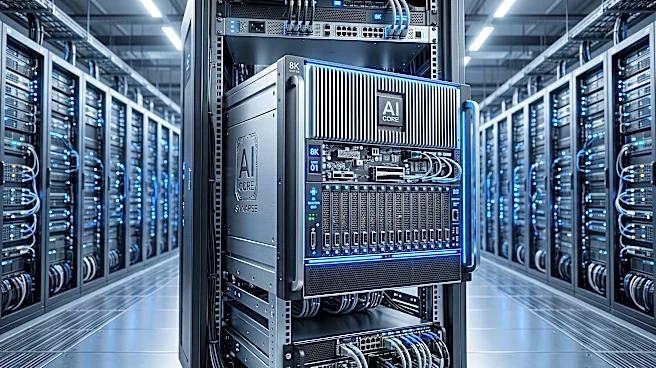
Server Edition GPUs, offering significant performance enhancements. Specifically, G7 instances provide up to 4.6 times faster AI inference performance and up to 2.1 times better graphics performance compared to their predecessors, G6 instances. The metal size of G7 instances is designed for specialized workloads that require direct access to bare metal infrastructure, such as physical AI simulations, AI agent sandboxes, and graphics acceleration. These instances support custom virtualization stacks, hypervisor-level GPU drivers, and licensing-restricted applications. Each G7 metal instance is equipped with 8 NVIDIA RTX PRO 4500 Blackwell Server Edition GPUs, each having 32 GB of memory, and custom Intel Xeon 6 processors. They also feature 192 virtual CPUs (vCPUs), 768 GiB of system memory, and 700 Gbps of Elastic Fabric Adapter (EFA) networking bandwidth. Currently, this new metal size is available in the AWS US East (N. Virginia) Region. Customers can acquire G7 metal instances through On-Demand Instances, Spot Instances, or as part of Savings Plans, utilizing the AWS Management Console, AWS Command Line Interface (AWS CLI), or AWS SDKs.
Why It's Important?
The introduction of the metal size for Amazon EC2 G7 instances marks a significant advancement for U.S. businesses and developers relying on high-performance computing. The substantial improvements in AI inference and graphics performance will enable companies to accelerate complex workloads, leading to faster development cycles and more sophisticated applications. Industries such as artificial intelligence, machine learning, scientific research, and advanced graphics rendering stand to benefit immensely. The ability to access bare metal infrastructure provides greater control and flexibility for specialized applications, which is crucial for workloads with specific hardware or licensing requirements. This development can foster innovation in AI and graphics-intensive fields, potentially leading to new products and services. Furthermore, the availability in the US East (N. Virginia) Region, a major AWS hub, ensures that a broad range of U.S. enterprises can readily access these powerful computing resources, enhancing their competitive edge in a technology-driven global market. The flexible purchasing options also make these advanced capabilities accessible to a wider range of businesses, from startups to large enterprises.
What's Next?
Following the general availability in the US East (N. Virginia) Region, AWS may consider expanding the availability of G7 metal instances to other AWS regions across the United States and globally, based on customer demand and strategic priorities. This expansion would further broaden access to these high-performance computing resources for a wider array of businesses and developers. We can anticipate that companies in sectors such as autonomous driving, medical imaging, and advanced simulation will begin to integrate these new instances into their infrastructure to leverage the enhanced AI and graphics capabilities. AWS will likely continue to gather feedback from early adopters to refine and improve the G7 instance offerings, potentially leading to further optimizations or new features. Additionally, the increased performance offered by G7 instances could drive the development of more demanding AI models and graphics applications, pushing the boundaries of what is currently possible in cloud computing. The competitive landscape among cloud providers may also intensify as rivals respond with their own enhanced offerings to match or surpass the capabilities of the G7 instances.
Beyond the Headlines
The release of G7 metal instances underscores a broader trend in cloud computing towards specialized hardware tailored for specific, high-demand workloads. This move reflects the increasing importance of AI and advanced graphics in various industries, pushing cloud providers to offer more granular control and raw performance. The emphasis on bare metal access highlights a recognition that not all workloads can be efficiently virtualized, especially those requiring direct hardware interaction or specific driver configurations. This could lead to a re-evaluation of traditional cloud deployment models, with more hybrid approaches emerging that combine the flexibility of virtualized environments with the performance of bare metal. Ethically, the increased power of AI inference could accelerate the development of AI systems with more complex decision-making capabilities, raising questions about AI governance and responsible AI development. Legally, the support for licensing-restricted applications on bare metal could simplify compliance for certain software vendors, potentially opening up new markets for cloud adoption in highly regulated industries. Culturally, the widespread availability of such powerful computing resources could democratize access to advanced AI and graphics development, fostering innovation from a broader base of developers and researchers.