








What's Happening?
AGIBOT, a leader in embodied AI and robotics, has announced the production of its 15,000th robot, marking a significant milestone in its scaling journey. Founded in February 2023, the company has rapidly increased its production capabilities, moving from
1,000 to 5,000 units, then to 10,000, and now reaching 15,000 units. This achievement highlights AGIBOT's ability to transition from early product validation to large-scale production and real-world deployment. The milestone unit, the AGIBOT G2, is designed for industrial and operational scenarios, showcasing the company's engineering delivery capabilities. The rollout was celebrated by Dr. Yao Maoqing, Senior Vice President and President of the Embodied AI Business Unit at AGIBOT, who emphasized the importance of this milestone in the broader industry's move toward scaled deployment in real-world settings.
Why It's Important?
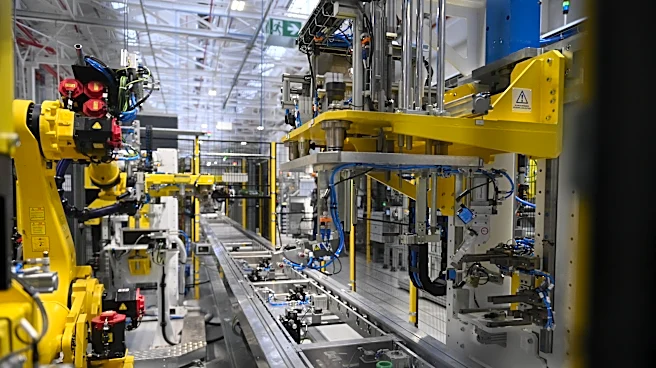
The production of AGIBOT's 15,000th robot is a significant indicator of the growing industrialization of embodied AI. This milestone not only reflects AGIBOT's production capabilities but also signals a broader industry trend towards large-scale deployment of AI robots in real-world applications. As the industry shifts from proof-of-concept projects to practical applications, the ability to sustain large-scale production and deployment becomes crucial. This development could impact various sectors, including manufacturing, where robots like the AGIBOT G2 are integrated into production lines, enhancing efficiency and productivity. The milestone also underscores AGIBOT's leadership in the global market, as it ranked first in humanoid robot shipments in 2025, according to market research firm Omdia.
What's Next?
AGIBOT plans to continue expanding its production and deployment capabilities, bringing more robots into real-world scenarios. The company aims to advance the industrialization of embodied AI through scaled delivery and deployment. This includes strengthening its supply chain and quality control systems to ensure consistent production and reliable delivery. As more robots enter industrial, commercial, and public-service environments, AGIBOT's ability to sustain large-scale production will be a key measure of its industrialization capability. The company is also likely to explore new applications and markets for its robots, further solidifying its position as a leader in the embodied AI industry.
Beyond the Headlines
The milestone achieved by AGIBOT highlights the evolving landscape of robotics and AI, where the focus is shifting from individual robot demonstrations to large-scale, real-world applications. This transition raises important considerations about the integration of AI in various sectors, including ethical and regulatory challenges. As robots become more prevalent in workplaces, issues such as job displacement, data privacy, and the need for new regulatory frameworks may arise. Additionally, the success of companies like AGIBOT could drive further innovation and competition in the AI and robotics industries, potentially leading to new technological advancements and applications.