





What's Happening?
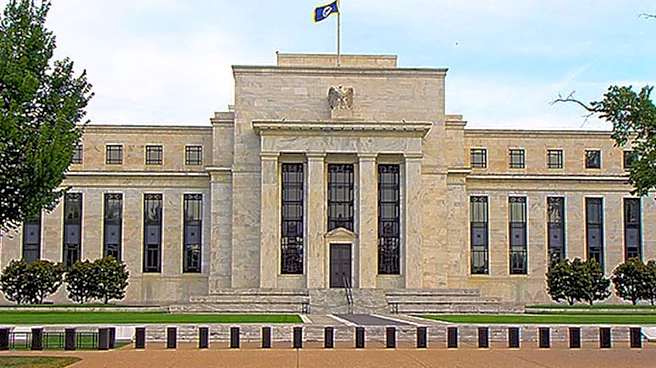
The Federal Reserve's recent interest rate hike in September 2026, the first since 2023, has influenced Certificate of Deposit (CD) rates, with some increasing after the decision. This follows a period in 2025 where the Federal Reserve cut its benchmark
federal funds rate three times, leading many banks to reduce their CD and savings interest rates. Currently, the most competitive CD rate observed is 5.05% APY for a 4-year CD issued by Morgan Stanley, as of November 10, 2026. CD yields generally move in conjunction with Federal Reserve policy adjustments, particularly the federal funds rate, which dictates what banks pay each other for overnight lending. The Fed's strategy involves reducing the federal funds rate to lower borrowing costs and raising it to make borrowing more expensive, as seen during the COVID-19 outbreak and subsequent inflationary periods.
Why It's Important?
The fluctuation in CD rates directly impacts savers and investors looking for secure, fixed-income options. With the Federal Reserve raising interest rates to combat inflation, CDs become a more attractive option for individuals seeking higher returns on their savings compared to traditional savings accounts. Locking in a CD now, especially with competitive rates like Morgan Stanley's 5.05% for a 4-year term, can provide a hedge against future economic uncertainty and potential rate cuts. This is particularly relevant for those preparing for an unpredictable economic future. While shorter-term CDs might offer higher APYs in some instances, longer-term CDs provide better protection against future rate reductions by the Fed. The availability of such rates encourages consumers to consider their savings strategies and potentially shift funds to capitalize on these higher yields.
What's Next?
As the Federal Reserve continues its monetary policy adjustments, including anticipated further rate hikes, CD rates are likely to remain dynamic. Investors should monitor the Federal Open Market Committee (FOMC) meetings, with the next one scheduled for December 8-9, as these decisions directly influence CD yields. Financial institutions, particularly online banks, may continue to offer competitive rates due to lower overhead costs. Consumers are advised to compare rates across various banks and credit unions, considering term length, APY, deposit requirements, and early withdrawal penalties. The ongoing economic environment, characterized by the Fed's efforts to manage inflation, suggests that locking in favorable CD rates now could be a prudent financial move for those seeking stable returns.
Beyond the Headlines
The current environment of rising CD rates reflects a broader economic narrative where the Federal Reserve is actively working to normalize monetary policy after years of accommodative measures. This shift has significant implications for the financial landscape, encouraging a return to more traditional savings vehicles. The emphasis on competitive CD rates also highlights the increasing sophistication of consumers in seeking out the best returns for their money, moving beyond conventional brick-and-mortar banks. This trend could lead to greater competition among financial institutions, potentially driving up rates further to attract deposits. Moreover, the strategic decision to lock in long-term CDs now could be seen as a defensive play against potential future economic downturns or a return to lower interest rate environments, offering a degree of financial predictability in uncertain times.