




What's Happening?
NEXCOM Robotic Solutions is providing ruggedized edge computing platforms designed to serve as fail-safe Logic Solvers in industrial automation. These platforms are crucial for achieving Safety Integrity Level 2 (SIL2) compliance, a stringent mathematical
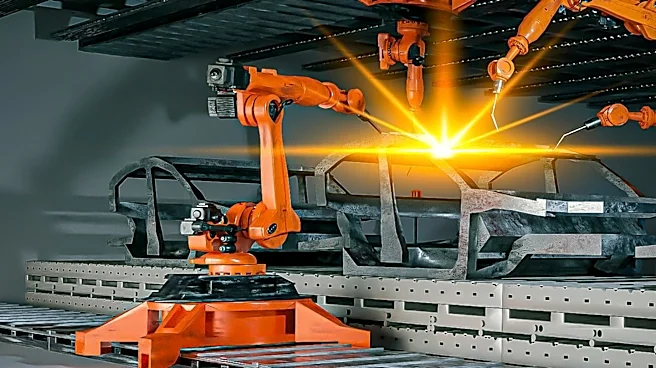
mandate for safety functions in industrial environments. SIL2 requires a Risk Reduction Factor (RRF) of 100 to 1,000, meaning the Probability of Dangerous Failure per Hour (PFH) must be between 10^-6 and 10^-7. This level of safety is predominantly mandated in discrete manufacturing and industrial robotics where severe kinetic hazards necessitate highly deterministic control architectures. The company's edge architectures enable the strict isolation of deterministic safety logic on reliable, SIL2-capable control pathways, preventing high-bandwidth AI inference from interfering with critical shutdown sequences. This approach is vital for applications such as robotic systems operating near human workers, automated production machines with moving parts, and motion control systems requiring safe stop functions.
Why It's Important?
The implementation of SIL2-ready edge computing platforms by NEXCOM Robotic Solutions is critical for enhancing safety and reliability in U.S. industrial automation and manufacturing sectors. As factories increasingly adopt software-defined manufacturing and collaborative robotics, the risk profile for human operators working alongside high-speed machinery has fundamentally changed. SIL2 compliance ensures that safety is architected into the core of these systems, reducing the probability of dangerous failures and protecting workers. This is particularly important for robot builders, machine builders, and system integrators who must design safety functions that meet rigorous standards. Beyond safety, these systems offer operational benefits such as reduced unpredictable failure risks, built-in diagnostics that decrease reliance on manual inspection, and a lower total cost of ownership over time due to minimized unplanned downtime and maintenance troubleshooting. The ability to integrate high-performance motion control with functional safety also improves market competitiveness for U.S. manufacturers.
What's Next?
The adoption of SIL2-ready industrial safety architectures is expected to continue expanding as U.S. manufacturers strive for safer and more efficient operations. NEXCOM Robotic Solutions will likely continue to support robot builders and system integrators in deploying high-throughput automation that meets these strict compliance mandates. The focus will remain on ensuring that complex motion profiles and probabilistic AI perception in robotics and production machinery are underpinned by control hardware capable of executing deterministic safety logic with absolute reliability. Future developments may include further integration of advanced diagnostic capabilities and enhanced interoperability with industrial safety protocols to streamline the validation and maintenance of SIL2-compliant systems. Manufacturers will increasingly seek partners with expertise in industrial edge computing, robotics, and machine control to build the digital foundations necessary for safety-focused industrial systems.
Beyond the Headlines
The shift towards SIL2-compliant edge computing in industrial automation signifies a deeper evolution in the ethical and operational responsibilities of manufacturers. It underscores a growing recognition that technological advancement, particularly in AI and robotics, must be intrinsically linked with robust safety protocols. The strict workload isolation enforced by NEXCOM Robotic Solutions' platforms highlights a critical ethical consideration: ensuring that the pursuit of operational intelligence never compromises human safety. This approach also addresses the long-term societal impact of automation, fostering trust in advanced manufacturing processes by prioritizing worker protection. Furthermore, the emphasis on reducing unplanned downtime and improving diagnostic visibility points to a broader trend of optimizing industrial processes not just for efficiency, but for resilience and sustainability, ultimately contributing to a more secure and productive industrial landscape in the U.S.