




What's Happening?
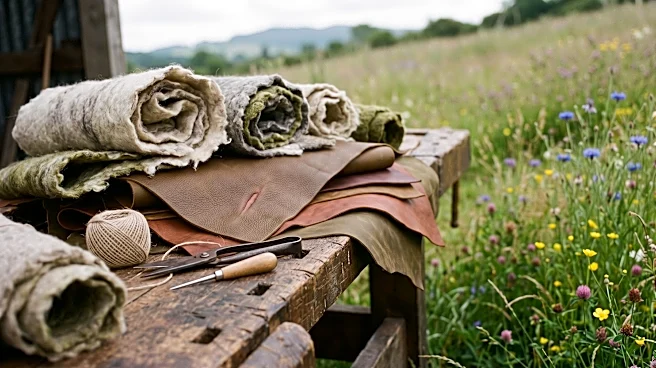
Johnny O'Mara, a first-generation shepherd in Mendocino County, Northern California, is dedicated to teaching the 'lost arts' of animal husbandry, including animal processing, hide tanning, and felting. O'Mara, who grew up on his family's property, initially
trained in horticulture before entering large-scale contract grazing for wildfire fuel reduction. After five years, he transitioned to tending a smaller flock of 40 goats for sustenance on his family land and working as a freelance ranch hand. His current focus is on leading workshops that aim to reconnect people with the sources of their food and foster a deeper relationship with land and animals. O'Mara emphasizes stewardship as creating conditions for more life, noting the return of wildflowers and native sedges on his grazed land. He advocates for ecologically managed grazing practices that prioritize soil health and biodiversity over aggressive vegetation removal.
Why It's Important?
O'Mara's work is significant as it addresses a growing disconnect between modern food systems and traditional agricultural practices. By teaching skills like animal processing and hide tanning, he is preserving knowledge that is often absent in contemporary society, promoting self-sufficiency, and fostering a more intimate understanding of food sources. His approach to shepherding highlights the ecological benefits of responsible grazing, such as increasing biodiversity, improving grassland health, and reducing wildfire risk. This model offers an alternative to industrial agriculture, emphasizing reciprocity and kinship with the land and animals. It also challenges common misconceptions about land management, advocating for practices that support long-term ecological balance rather than short-term solutions, which can have broader implications for sustainable land use and food security in the U.S.
What's Next?
O'Mara plans to expand his teaching efforts, aiming to inspire more people to live intimately with nature and feel competent in that connection. The increasing interest in his workshops suggests a growing demand for these traditional skills and a desire for more sustainable and ethical food practices. As awareness of ecological literacy and the impact of food systems grows, O'Mara's model could influence other small-scale farmers and land stewards to adopt similar approaches. His work may also contribute to a broader movement advocating for policy changes that support regenerative agriculture and local food economies. The continued success of his workshops could lead to the establishment of more educational programs focused on traditional animal husbandry and land stewardship across California and beyond.
Beyond the Headlines
O'Mara's philosophy extends beyond practical skills, delving into the ethical and cultural dimensions of human-animal relationships. He views animals not as objects but as subjects, promoting an animistic worldview in his processing classes. This perspective challenges the dominant cultural narrative that often distances consumers from the realities of food production. By emphasizing an 'ancient agreement' of reciprocity and indebtedness to the natural world, O'Mara encourages participants to consider their ecological footprint and the unseen impacts of their consumption choices. His work fosters a deeper sense of responsibility and connection to the environment, potentially leading to long-term shifts in how individuals perceive and interact with their food sources and the broader ecosystem. This re-evaluation of our relationship with nature could contribute to a more conscious and sustainable society.