






What's Happening?
Vertical Aerospace has inaugurated a new 60,000-square-foot assembly center for its Valo electric vertical takeoff and landing (eVTOL) aircraft at Cotswold Airport. This facility is designed to produce certification-conforming aircraft essential for compliance
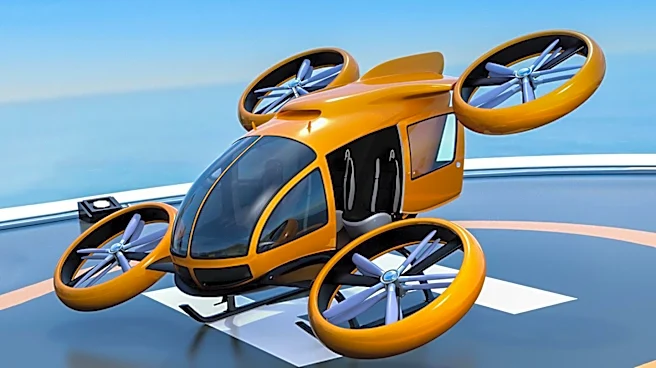
testing and is projected to assemble over 25 Valo aircraft annually during its initial production phase. The company aims to achieve Type Certification for the Valo in 2029. The Valo, unveiled in late 2025, is an evolution of the VX4 prototypes, designed to carry up to six people, cruise at 150 mph, and have a range of up to 100 miles. It is intended for short-distance passenger transport, such as airport connections. The new center, a refurbished World War II-era hangar, expands Vertical Aerospace's footprint at the airport to approximately 130,000 square feet, including its existing Flight Test Centre.
Why It's Important?
This development signifies a critical step in the commercialization of eVTOL technology, particularly for the U.S. market, as successful certification and production in the UK could pave the way for broader international adoption. The establishment of a dedicated assembly center underscores the growing investment and commitment to advanced air mobility (AAM) solutions. For the U.S. aviation industry, the progress of companies like Vertical Aerospace indicates future shifts in urban and regional transportation, potentially creating new economic opportunities in manufacturing, maintenance, and operational services. The Valo's design for short-distance passenger transport could alleviate congestion in metropolitan areas and enhance connectivity between regional hubs, impacting travel patterns and infrastructure development. The focus on certification-conforming aircraft is crucial for building regulatory confidence and public trust in this nascent sector.
What's Next?
Assembly of the first certification-conforming Valo aircraft is slated to commence at Cotswold Airport in the fourth quarter of 2027, with flight testing anticipated to begin in 2028. Seven Valo aircraft are designated for the certification campaign, comprising five for flight testing and two for ground structural tests. Before these certification aircraft are assembled, Vertical Aerospace plans to convert an existing prototype into a hybrid-electric demonstrator, with flight testing for this longer-range configuration scheduled for the first half of 2027. The company intends to announce the location of a separate, full-scale production facility for higher-volume manufacturing in the fourth quarter of 2026, with a long-term goal of producing over 900 aircraft annually by 2035. Additionally, Vertical Aerospace is expanding its battery operations in Avonmouth, near Bristol, to triple battery production capacity as the Valo program progresses toward certification.
Beyond the Headlines
The scaling of eVTOL production, as demonstrated by Vertical Aerospace's new facility, highlights a broader trend towards sustainable and efficient urban air mobility. This shift could have profound implications for urban planning, noise pollution regulations, and energy infrastructure. The successful integration of eVTOLs into existing airspace will require significant advancements in air traffic management systems and regulatory frameworks, potentially leading to new international standards. Furthermore, the development of these aircraft could spur innovation in related fields, such as battery technology, lightweight materials, and autonomous flight systems. The long-term vision of making personal eVTOLs as ubiquitous as bicycles, as expressed by other industry players, suggests a future where air travel is democratized, raising questions about accessibility, equity, and the environmental footprint of widespread aerial transport.