







What's Happening?
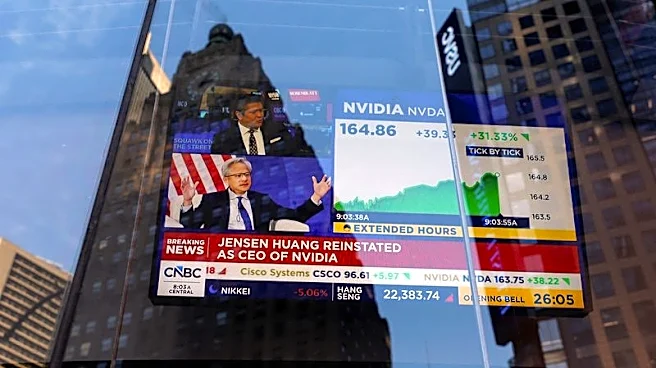
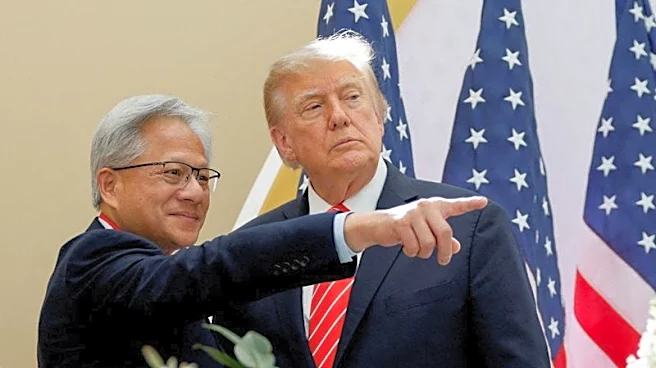
President Trump has taken credit for the reinstatement of Jensen Huang as CEO of Nvidia, following allegations of extramarital affairs and espionage concerns. According to MS NOW, stocks surged after the announcement, which President Trump described to CNBC
as the market shifting from 'a rocket ship going in the wrong direction' to 'a rocket ship going in the right direction' due to his intervention. This event highlights President Trump's consistent focus on the stock market as a key indicator of his administration's success. He has frequently used market performance, particularly the S&P 500 numbers, in his campaign rallies to demonstrate economic strength. However, his stance on the market's significance has varied, with him downplaying its importance when his policies, such as new tariffs, led to dips. Dr. David Kass, a clinical professor of finance at the University of Maryland, noted that the S&P 500 has historically increased by about 10% annually regardless of the presidential administration, suggesting that economic growth can occur independently of specific White House policies.
Why It's Important?
President Trump's assertion of influence over corporate decisions and market movements carries significant implications for the perception of presidential power and economic policy. His public claims of direct impact on Nvidia's leadership and subsequent stock performance could influence investor confidence and corporate governance practices, potentially leading to increased scrutiny of political involvement in private sector affairs. The debate over whether market success is attributable to presidential actions or broader economic trends is crucial for understanding economic policy effectiveness. If the public perceives that a president can directly manipulate market outcomes, it could alter expectations for government intervention in the economy. Furthermore, the focus on stock market performance as a primary measure of economic health, as emphasized by President Trump, may overshadow other economic indicators, such as the cost of living and income inequality, which disproportionately affect different segments of the population, particularly those less invested in the stock market.
What's Next?
The continued emphasis by President Trump on stock market performance as a measure of national success is likely to remain a central theme in his public discourse and potential future political campaigns. This approach could lead to ongoing debates about the true drivers of economic prosperity and the appropriate metrics for evaluating presidential economic policies. Financial analysts and economists will likely continue to scrutinize claims of direct presidential influence on market fluctuations, offering alternative explanations based on broader economic fundamentals and corporate developments. The reinstatement of Jensen Huang at Nvidia, irrespective of President Trump's claims, will be watched for its impact on the company's strategic direction and market position, especially given the prior allegations. Future market movements will undoubtedly be framed by political figures as either validation or repudiation of their economic strategies, further intertwining political rhetoric with financial outcomes.
Beyond the Headlines
The narrative surrounding President Trump's influence on the stock market and corporate decisions delves into deeper questions about the intersection of politics, business, and public perception. The tendency to attribute market gains or losses directly to a single political figure, while common, often oversimplifies complex economic dynamics. This simplification can create a public expectation that political leaders have direct control over market forces, potentially leading to misinterpretations of economic health and policy effectiveness. Ethically, the blurring of lines between political rhetoric and corporate governance raises concerns about potential undue influence or the perception thereof, which could impact investor trust and corporate independence. Culturally, the 'rocket ship' metaphor used by President Trump reflects a broader societal fascination with rapid growth and success, often overlooking underlying economic vulnerabilities or the uneven distribution of benefits from market prosperity. This focus on headline numbers can distract from more nuanced discussions about long-term economic stability and equitable growth.