









What's Happening?
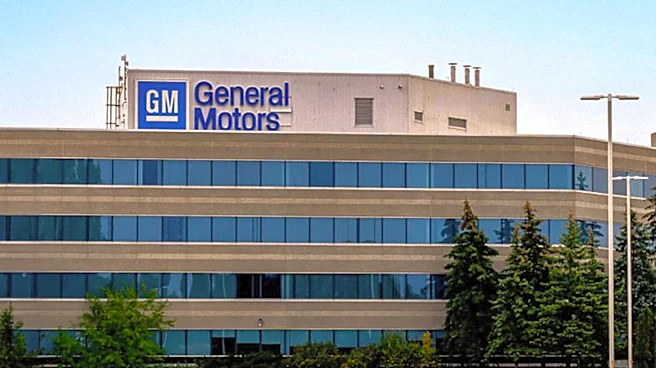
General Motors (GM) announced its decision to transfer the listing of its common stock from the New York Stock Exchange (NYSE) to the Nasdaq Stock Market. The move is scheduled to take effect on November 17, with GM shares expected to begin trading as a Nasdaq-listed
company on that date. The automaker stated that its ticker symbol will remain "GM." According to GM CFO Paul Jacobson, this transition aligns with GM's strategy to position itself as a technology-focused company, emphasizing its customer-centric and technology-driven approach. The company also noted that this move could make it eligible for inclusion in the Nasdaq-100 Index. Current shareholders are not required to take any action regarding this transfer.
Why It's Important?
This stock exchange transfer is significant as it reflects GM's strategic repositioning in the market, aiming to be perceived more as a technology innovator rather than solely a traditional automaker. Moving to Nasdaq, historically associated with technology companies, could enhance GM's appeal to a different investor base and potentially improve its valuation. The eligibility for inclusion in the Nasdaq-100 Index could also lead to increased investor interest and liquidity, as many index funds track this benchmark. For the NYSE, GM's departure marks a notable loss, given its long history on the exchange since 1911 and its relisting in 2010 after bankruptcy. This trend of companies moving from NYSE to Nasdaq indicates a broader shift in how established industries are seeking to align their market identity with technological advancements.
What's Next?
General Motors will officially begin trading on the Nasdaq Stock Market on November 17, under its existing ticker symbol "GM." Following the transfer, market analysts and investors will closely monitor GM's stock performance and its integration into the Nasdaq ecosystem. The company will likely continue to emphasize its technological advancements, particularly in areas like artificial intelligence and self-driving vehicles, to reinforce its new market positioning. The potential for inclusion in the Nasdaq-100 Index will be a key point of interest, as such an event could trigger further investment from index-tracking funds. Other companies may observe GM's transition as they consider similar moves to align with the technology-focused narrative of Nasdaq.
Beyond the Headlines
GM's move to Nasdaq signifies more than just a change in listing venue; it represents a symbolic shift in the automotive industry's identity. As vehicles become increasingly software-defined and integrated with advanced technologies, traditional automakers are striving to shed their legacy image and compete with tech giants. This transfer underscores the convergence of the automotive and technology sectors, where innovation in areas like electric vehicles, autonomous driving, and connectivity is paramount. The decision also highlights the competitive landscape between stock exchanges, with Nasdaq actively attracting companies by emphasizing its tech-centric brand and investor relations services. This trend could lead to a broader re-evaluation of how various industries are categorized and valued in the financial markets, blurring the lines between traditional sectors and the technology sphere.