
What's Happening?
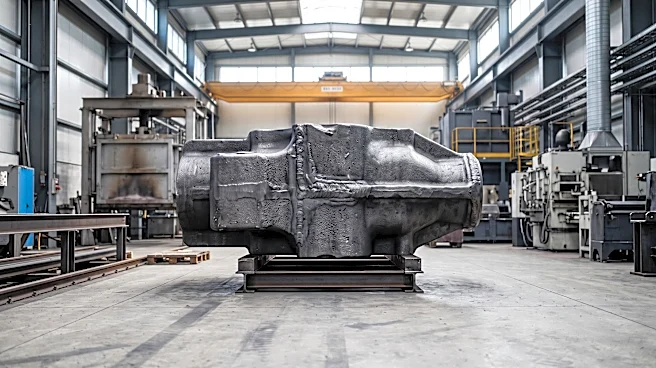
Hadrian, a company focused on reindustrializing American manufacturing through autonomous factories, operates Factory 2 in Torrance, California. This facility specializes in machining, inspecting, and
shipping precision aerospace and defense parts. Key customers include SpaceX, General Atomics, Woodward, and K2 Space. Hadrian leverages AI, advanced software, robotics, and full-stack manufacturing to produce mission-critical systems up to ten times faster and at significantly lower costs. The company recently secured $1.37 billion in Series D funding, valuing it at $7.87 billion, and is expanding its manufacturing capabilities to include welding, casting, forging, electronics, and additive manufacturing. Hadrian aims to transform how critical products are built by scaling its Factory-as-a-Service platform, supported by investors such as JPMorgan Chase, Valor Equity Partners, and Andreessen Horowitz. The company is actively hiring for roles like Factory Lead to manage production areas and ensure operational excellence.
Why It's Important?
Hadrian's operations are crucial for strengthening the U.S. aerospace and defense industrial base. By accelerating the production of complex components, Hadrian directly supports critical national security and space exploration initiatives. The company's focus on autonomous factories and advanced manufacturing techniques addresses long-standing challenges in supply chain efficiency and cost reduction within these sectors. This approach not only enhances the competitiveness of U.S. manufacturers but also creates high-skilled jobs, contributing to economic growth and technological leadership. The ability to produce parts faster and more affordably can significantly impact the development timelines and budgets for next-generation rockets, satellites, aircraft, and other defense systems, benefiting both government agencies and private aerospace firms. The expansion of Hadrian's capabilities signifies a broader trend towards advanced manufacturing in the U.S., aiming to reduce reliance on foreign supply chains and bolster domestic production capacity.
What's Next?
Hadrian plans to continue expanding its manufacturing footprint and launching new capabilities across various advanced manufacturing processes. This expansion will likely involve further investment in AI, robotics, and software integration to enhance factory autonomy and efficiency. The company will also focus on scaling its Factory-as-a-Service platform, which could lead to broader adoption of its manufacturing model by other aerospace and defense contractors. Recruitment efforts for specialized roles, such as Factory Leads, will continue as Hadrian builds out its teams to manage increased production demands. Future developments may include partnerships with more aerospace and defense companies, further solidifying its role as a key supplier of precision components. The success of Hadrian's model could also inspire other industries to adopt similar autonomous manufacturing approaches, driving innovation across the U.S. industrial landscape.
Beyond the Headlines
The rise of companies like Hadrian signifies a fundamental shift in American manufacturing, moving towards highly automated and data-driven production environments. This transformation has profound implications for the future of work, requiring a workforce with advanced technical skills in areas like AI, robotics, and data analytics. The emphasis on domestic manufacturing also addresses strategic concerns about national security and economic resilience, particularly in critical sectors like aerospace and defense. By reducing lead times and costs, Hadrian's model could democratize access to advanced manufacturing capabilities, enabling smaller companies and startups to innovate more rapidly. Furthermore, the integration of AI in manufacturing raises ethical considerations regarding job displacement and the need for robust retraining programs to ensure a smooth transition for the labor force. The long-term impact could be a more agile, resilient, and technologically advanced U.S. manufacturing sector capable of responding quickly to global challenges.