






What's Happening?
John Law, a co-founder of Burning Man, has publicly stated that the annual Black Rock Desert gathering has 'lost its anarchist soul' and become a 'commercialized escape hatch' for the wealthy. In an essay published in The San Francisco Standard, Law, who
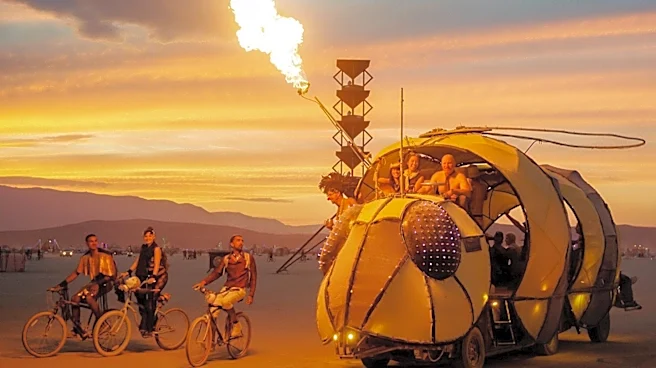
has not attended the event since 1996, described the modern Burning Man as 'barely recognisable' from its original countercultural iteration. He characterizes it as an 'immersive spectacle built for the consumption of Western elites and the middle-class creatives who service them,' likening it to a 'fabulous Disneyland for the well-heeled.' Law points to the increasing presence of luxury camping, private chefs, stylists, and charter flights as evidence of this shift. He attributes the festival's transformation to its expansion, particularly after the internet boom and the embrace of the event by Silicon Valley figures like Elon Musk, Sergey Brin, Larry Page, Mark Zuckerberg, and Jeff Bezos, which he believes led to a 'Silicon Valley takeover.'
Why It's Important?
Law's critique highlights a significant debate within the Burning Man community and broader counterculture movements regarding authenticity versus commercialization. His comments underscore the tension between the festival's founding principles of radical self-reliance, decommodification, and anti-authoritarianism, and its current perception as an exclusive, high-cost event. This shift could alienate long-time participants and those who identify with its original ethos, potentially impacting attendance and the nature of participation. The criticism also reflects a larger societal discussion about how countercultural movements evolve when they gain mainstream popularity and attract significant wealth, raising questions about whether their core values can be maintained amidst commercial pressures and increased accessibility for the affluent. The perceived 'Disneyfication' could diminish the event's unique appeal and its role as a space for genuine artistic and social experimentation.
What's Next?
The criticisms from John Law are likely to fuel ongoing discussions and introspection within the Burning Man organization and its community. While the festival continues to attract tens of thousands of attendees, the debate over its identity and direction is expected to persist. Organizers may face pressure to address concerns about commercialization and exclusivity, potentially leading to re-evaluations of ticketing models, camp regulations, and efforts to reinforce the event's core principles. However, given the scale and established nature of the festival, significant immediate changes are unlikely. The discourse may also influence how future participants approach the event, with some potentially seeking to uphold the original 'anarchist soul' through their own contributions and interactions, while others may continue to embrace the more commercialized aspects. The long-term impact could involve a further divergence in participant experiences and expectations.
Beyond the Headlines
The evolution of Burning Man, as described by John Law, reflects a broader phenomenon where countercultural movements, once niche and anti-establishment, become integrated into mainstream culture and even luxury consumption. This raises ethical questions about the commodification of experiences and the accessibility of spaces designed for radical self-expression. The festival's shift from an experimental playground for artists and free thinkers to a destination for the tech elite highlights the influence of wealth and status on cultural phenomena. It also prompts reflection on the sustainability of 'radical' principles when confronted with massive growth and commercial interest. The debate extends beyond Burning Man, touching upon how any movement or community struggles to maintain its original intent and inclusivity as it gains popularity and attracts diverse, often affluent, participants, ultimately challenging its foundational identity and purpose.