







What's Happening?
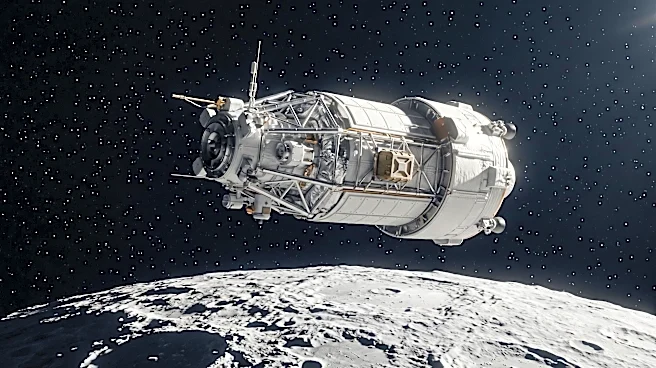
Firefly Aerospace has announced a commercial payload agreement with Starcloud to demonstrate artificial intelligence computing capabilities in lunar orbit. This collaboration involves Starcloud's SC-1L computing payload flying aboard Firefly's Elytra
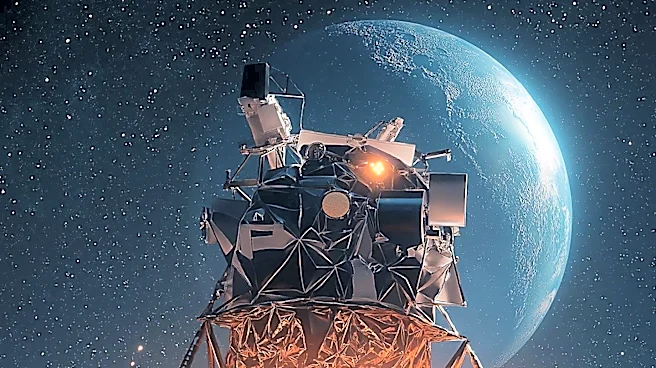
orbital vehicle. The mission, targeted for no earlier than 2028, aims to validate the capabilities for a future data center around the Moon. The SC-1L payload will ingest data from Firefly's onboard Solux vision system, perform AI computing in orbit, and then transmit the processed data back to Earth. This initiative follows Starcloud's previous successful AI computing demonstration in low Earth orbit, extending this technology to the lunar environment. The Elytra vehicle will also serve as a transfer vehicle and communications relay for Firefly's Blue Ghost lander, which is part of NASA's Commercial Lunar Payload Services initiative, targeting a landing on the Moon's Gruithuisen Domes.
Why It's Important?
This partnership signifies a crucial step in establishing robust infrastructure around the Moon, moving beyond basic transportation and landing services. By demonstrating AI computing in lunar orbit, Firefly Aerospace and Starcloud are laying the groundwork for future lunar data centers, which could significantly enhance data processing capabilities for scientific research, resource detection, and long-term human presence on the Moon. Processing data in orbit, rather than transmitting raw data back to Earth, can reduce bandwidth requirements and latency, making lunar operations more efficient. This development could attract further investment and innovation in lunar technology, potentially creating new commercial opportunities for U.S. companies in the burgeoning space economy. The ability to perform advanced analytics directly in lunar orbit could accelerate discoveries and improve the autonomy of lunar missions, benefiting both government and private sector endeavors.
What's Next?
The Starcloud payload is scheduled to join Firefly's third lunar mission, targeted for no earlier than 2028. Prior to this, Firefly plans to deploy its first Elytra vehicle into lunar orbit with Blue Ghost Mission 2, which is targeted to launch no earlier than 2027. Following its role as a transfer vehicle and communications relay for the Blue Ghost lander, the Elytra vehicle is designed to remain in lunar orbit for up to five years to support customer payload and imaging operations, including the Starcloud computing demonstration. Firefly Aerospace also recently announced a collaboration with NVIDIA to process data on orbit for its Ocula lunar imaging service, which provides lunar surface mapping, mineral detection, and reconnaissance. These upcoming missions and collaborations indicate a concerted effort to build a sustainable and technologically advanced lunar infrastructure.
Beyond the Headlines
The demonstration of AI computing in lunar orbit has profound implications for the future of space exploration and commercialization. It represents a shift towards decentralized data processing, where complex computations can occur closer to the source of data generation, rather than relying solely on Earth-based infrastructure. This could lead to more autonomous lunar missions, where AI systems can make real-time decisions based on processed data, reducing the need for constant human intervention from Earth. Ethically, this raises questions about the governance and control of AI systems operating in extraterrestrial environments. Legally, it could necessitate new international frameworks for data ownership, privacy, and security in space. Culturally, it pushes the boundaries of human presence beyond Earth, envisioning a future where the Moon is not just a destination but a hub for advanced technological operations, potentially fostering a new era of lunar industrialization and scientific discovery.