





What's Happening?
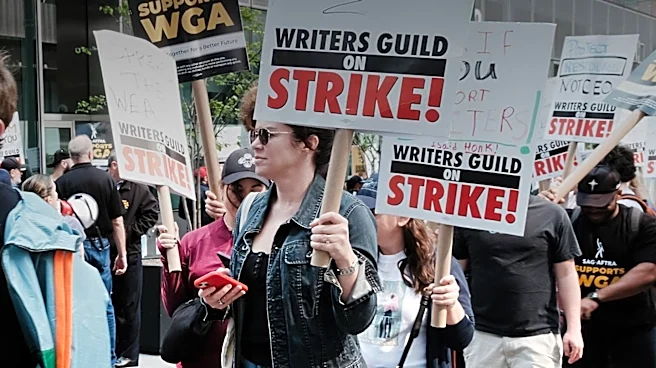
Dozens of Israeli-Americans and members of the Jewish community protested outside the Laemmle NoHo 7 theater in North Hollywood during a screening of the documentary 'NAZA.' The film, by Yuval Abraham and Rachel Szor, aims to examine the systems behind
the mass killing of Palestinian civilians. Protesters, some wrapped in Israeli and American flags, held signs advocating for factual accuracy, such as 'Learn the Facts. Know the Truth.' and 'Movies Have Editors. History Does Not.' They also displayed images documenting the October 7 attack and posters calling for the return of hostages. The Israeli-American Council (IAC) organized the protest, stating their message is to counter what they perceive as incomplete or biased narratives about Israel. IAC co-chair Tal Shuster emphasized that while they respect freedom of speech, they advocate for presenting all facts, including the experiences of October 7 victims and survivors.
Why It's Important?
This protest highlights the deep divisions and emotional intensity surrounding the Israeli-Palestinian conflict, particularly in the U.S. The demonstration underscores the ongoing struggle over narrative control and the demand for comprehensive storytelling when depicting such sensitive events. For the Israeli-American community, the protest represents an effort to ensure that the experiences of Israeli victims and hostages from the October 7 attack are not overlooked or minimized in public discourse and artistic representations. The call for a balanced presentation of facts reflects a broader concern about how media and cultural productions shape public opinion and understanding of complex geopolitical issues. This event also illustrates the challenges faced by filmmakers and artists who tackle highly charged subjects, as their work can become a focal point for existing societal tensions and differing perspectives.
What's Next?
The protest against 'NAZA' in Los Angeles, following a similar demonstration at its New York premiere, suggests that the film will continue to be a point of contention as it screens across the U.S. Such events are likely to spark further discussions about artistic freedom versus factual representation, and the responsibilities of filmmakers when addressing conflict. The Israeli-American Council and similar organizations are expected to continue their advocacy for a more complete narrative, potentially organizing more protests or educational campaigns. This situation could also influence how other cultural institutions approach programming related to the Israeli-Palestinian conflict, potentially leading to increased scrutiny or demands for accompanying discussions and diverse viewpoints. The ongoing debate underscores the difficulty of achieving consensus or even mutual understanding on deeply entrenched historical and political issues.
Beyond the Headlines
The 'NAZA' protest transcends a simple disagreement over a film; it reflects a broader cultural and ethical challenge in representing conflict. It raises questions about the role of art and documentary filmmaking in shaping public perception, especially when dealing with events that are still raw and deeply traumatic for many. The demand for 'all the facts' highlights the tension between artistic interpretation and journalistic accuracy, and the expectation that cultural products should not only inform but also acknowledge the full spectrum of human suffering. This event also points to the increasing polarization within society, where even cultural events become battlegrounds for competing narratives, making it difficult to foster empathy and understanding across different communities. The long-term implication is a continued struggle for nuanced and inclusive storytelling in a world often driven by simplified, emotionally charged accounts.