



What's Happening?
Skild AI, a U.S.-based company, announced on January 14, 2026, that it has successfully raised $1.4 billion in a Series C funding round. This significant investment was led by SoftBank Group, pushing the company's valuation to over $14 billion. Founded
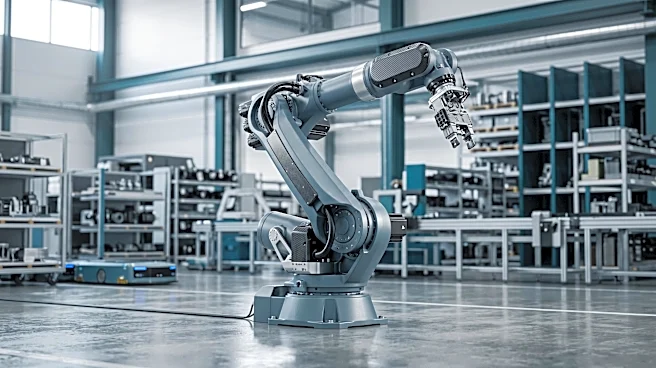
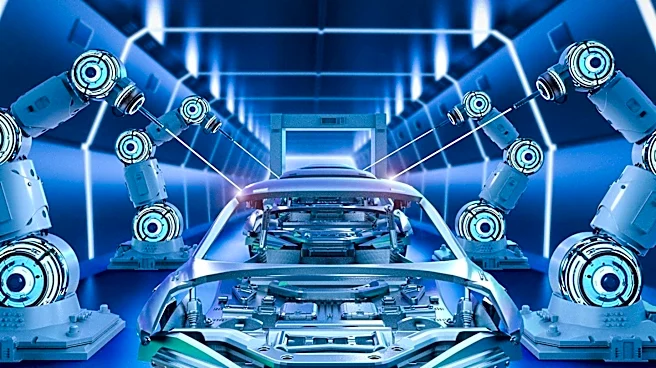
in Pittsburgh by former Carnegie Mellon University researchers Deepak Pathak and Abhinav Gupta, Skild AI is focused on developing an advanced AI model designed to control various types of robots, including industrial arms and humanoids. The core objective of this model is to enable robots to learn new tasks without requiring individual programming for each device and task. This innovation aims to streamline the deployment of robots across diverse operational environments such as factories and warehouses. By September 2026, Skild AI reported achieving $100 million in annual recurring revenue, serving over 60 customers, and engaging in projects with major industry players like Nvidia and Foxconn for robotic assembly applications, as well as operational trials in kitchens with Mitsui.
Why It's Important?
This substantial funding round for Skild AI underscores a growing investor confidence in the potential of AI models to revolutionize robotics and automation within the U.S. and globally. The company's approach to developing a universal AI model for robot control addresses a critical bottleneck in the broader adoption of robotics: the need for extensive, task-specific programming. By enabling robots to learn new tasks more autonomously, Skild AI's technology could significantly reduce operational complexities and costs for businesses looking to integrate automation. This development is particularly important for U.S. industries facing labor shortages and seeking to enhance productivity and efficiency in manufacturing, logistics, and other sectors. The success of Skild AI also highlights a broader trend of venture capital shifting towards financing companies that aim to bridge the gap between AI's digital capabilities and its application in the physical world, signaling a new era for industrial automation and potentially reshaping the future of work.
What's Next?
Skild AI's immediate next steps will likely involve scaling its operations and further developing its foundational AI model to expand its capabilities across a wider range of robotic platforms and applications. The company's existing collaborations with industry giants like Nvidia, Foxconn, and Mitsui suggest a strategic focus on integrating its technology into real-world industrial and commercial settings. Future developments could include expanding its customer base beyond the current 60, exploring new sectors for robotic deployment, and refining its AI model to handle increasingly complex and nuanced tasks. The company's success in generating significant annual recurring revenue indicates a strong market demand for its solutions, which will likely drive further product innovation and market penetration. As the robotics and physical AI sector continues to attract substantial investment, Skild AI will be under pressure to demonstrate continued commercial viability and technological advancement to maintain its high valuation and investor interest.
Beyond the Headlines
The investment in Skild AI reflects a deeper shift in the technological landscape, moving towards a future where artificial intelligence is not just confined to digital realms but actively controls and enhances physical operations. This has profound implications for the U.S. economy and society. Ethically, the development of more autonomous and adaptable robots raises questions about job displacement and the need for workforce retraining programs. Legally, as robots become more capable of independent action, frameworks for accountability and liability in case of errors or accidents will need to evolve. Culturally, the widespread integration of intelligent robots in daily life and industrial settings could alter human-machine interactions and societal perceptions of automation. Skild AI's focus on a universal AI model for robots could also lead to a more standardized and interoperable robotics ecosystem, potentially accelerating innovation but also creating new challenges related to data privacy and security in interconnected robotic systems.