






What's Happening?
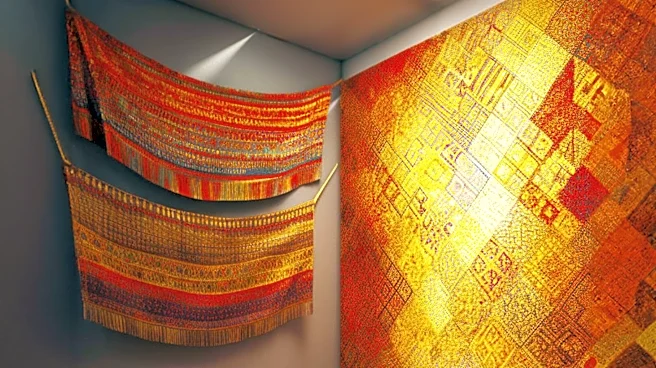
Hauser & Wirth in New York is currently featuring 'Jerry Meandering,' an exhibition of works by artist Mike Kelley. The exhibition showcases Kelley's collages, including pieces from his 'Collages 1974–2011' series. These compositions are noted for their
ability to hold back while still engaging the viewer, utilizing patterns that maintain unruly parts and absences that sustain attention. The collages often feature crude cuts against delicate printed paper, central black anti-forms, and fragile geometric elements. One untitled collage, for instance, displays a blue-and-white ornamental border framing an irregular star, with green and turquoise textures meeting orange lines and a violet triangle, interrupted by a square opening. The exhibition is on view at Hauser & Wirth, located at 443 West 18th Street, Chelsea, and will run through January 16.
Why It's Important?
This exhibition is significant for the art world as it offers a deeper look into Mike Kelley's artistic process and influences. Kelley, known for his complex and often provocative work, is presented through collages that reveal his engagement with themes of cultural memory and the reclamation of domestic materials. The works draw parallels to Miriam Schapiro's 'femmages,' highlighting Kelley's interest in a 'masculine version of what feminism did' by elevating handcrafts traditionally associated with women. This connection underscores a broader dialogue within art history regarding the valuation of different art forms and the gendered perceptions of artistic labor. The exhibition provides an opportunity for audiences to reconsider the historical context of Pop art and the critical reception of domestic subjects in art.
What's Next?
The exhibition 'Jerry Meandering' will continue to be open to the public at Hauser & Wirth in New York until January 16. Following its conclusion, the works may be integrated into private collections, museum retrospectives, or further scholarly analysis, contributing to the ongoing discourse surrounding Mike Kelley's legacy. Art critics and historians will likely continue to explore the connections between Kelley's collages and the feminist art movement, particularly the works of artists like Miriam Schapiro and Judy Chicago. The themes of childhood recovery, domestic imagery, and the recontextualization of everyday materials are expected to remain subjects of academic and artistic interest, potentially influencing contemporary artists and future exhibitions.
Beyond the Headlines
The exhibition delves into the deeper implications of art's relationship with memory and the subconscious. Kelley's approach, described as a 'reach back toward a state that was never free of anything,' suggests a complex engagement with the idea of recovering childhood, as theorized by Freud and George Boas. This perspective challenges the notion of a 'free' childhood, implying that even early experiences are shaped by societal and psychological forces. The collages, with their 'centralized embryonic fortresses,' evoke a sense of solitude and primal anxiety, guiding the viewer's gaze while maintaining a certain stillness. This exploration of internal landscapes and the reinterpretation of personal history through art offers a profound commentary on the human condition and the continuous process of self-discovery and artistic expression.