








What's Happening?
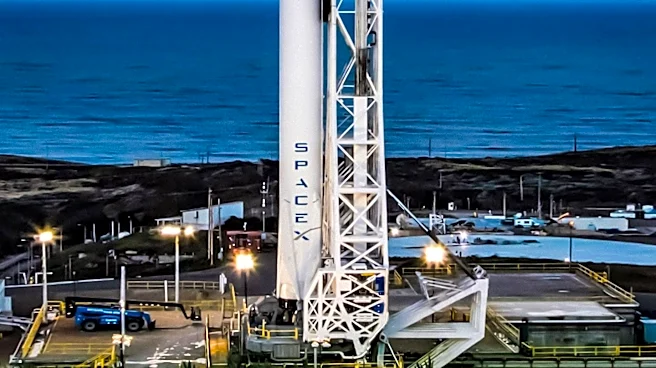
SpaceX successfully launched a Falcon 9 rocket carrying 29 Starlink satellites from Cape Canaveral early Tuesday morning. The mission, designated Starlink 10-45, took off at 5:10 a.m. ET from Space Launch Complex 40 at Cape Canaveral Space Force Station
in Florida. The Falcon 9 booster, identified as B1080, completed its 28th flight and landed on the drone ship 'A Shortfall of Gravitas' in the Atlantic Ocean for future reuse. This launch is part of SpaceX's ongoing efforts to expand its Starlink satellite internet megaconstellation, which aims to provide high-speed broadband to users worldwide. As of June 2026, the constellation consisted of approximately 10,413 operational satellites, making it the world's largest active satellite network. The satellites operate in low Earth orbit, about 342 miles above the planet's surface, allowing for lower latency and faster data transmission speeds compared to traditional geostationary satellites.
Why It's Important?
The expansion of the Starlink satellite network is significant as it aims to provide high-speed internet access to remote and underserved regions that lack traditional fiber-optic or cellular infrastructure. By positioning satellites in low Earth orbit, Starlink can offer lower latency and faster data transmission speeds, supporting activities such as streaming, online gaming, and video conferencing. This development is crucial for bridging the digital divide and ensuring that more people have access to reliable internet services. Additionally, the successful reuse of the Falcon 9 booster highlights SpaceX's commitment to reducing launch costs and increasing the sustainability of space missions.
What's Next?
SpaceX plans to continue accelerating Starlink launches throughout 2026, deploying dozens of satellites per mission to further expand network capacity and service reliability. The company aims to maintain continuous coverage across most of the globe by keeping multiple satellites overhead at any given location. As the constellation grows, SpaceX will likely focus on enhancing service quality and expanding its customer base, particularly in areas with limited internet access. The ongoing development of the Starlink network may also prompt regulatory discussions regarding satellite internet services and their impact on existing telecommunications infrastructure.