
What's Happening?
U.S. defense contractors are demonstrating strong financial performance, driven by substantial government spending and multi-year contract backlogs. Companies like Lockheed Martin, Northrop Grumman, General
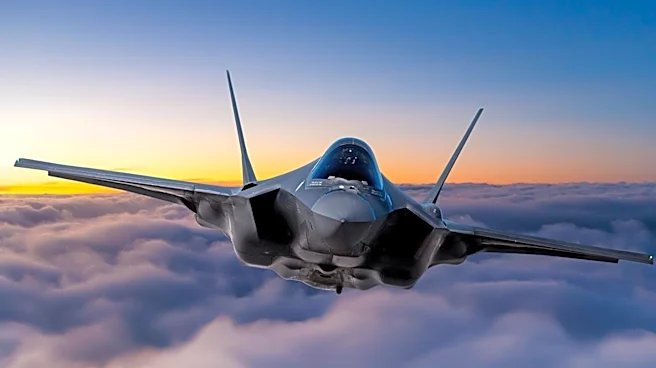
Dynamics, L3Harris Technologies, and RTX are highlighted for their ability to generate predictable cash flow and consistent dividend payouts. Lockheed Martin, for instance, boasts a record backlog and a dividend yield of 2.58%, supported by major programs such as the THAAD interceptor award and F-35 production. Northrop Grumman's dividend is underpinned by significant awards for the Sentinel ICBM and B-21 bomber, contributing to a record backlog of $104.69 billion. General Dynamics benefits from submarine work and Gulfstream sales, maintaining a consistent dividend increase history. L3Harris Technologies shows the fastest free cash flow growth among the group, with a record $42.0 billion backlog. RTX, with the largest backlog at $289 billion, is also committed to dividend growth, fueled by programs like the GEM-T Patriot Effectors and AMRAAM missiles. These companies are capitalizing on long-term defense spending commitments, which provide a stable revenue outlook.
Why It's Important?
The robust performance of these defense contractors underscores the significant and sustained investment by the U.S. government in its defense capabilities. This trend has broad implications for the U.S. economy, particularly for the industrial sector and the financial markets. The 'contractually backed forward revenue' enjoyed by these companies provides a level of financial stability rarely seen in other industries, making them attractive to income investors. The continuous flow of government contracts, often spanning decades, ensures predictable cash flow, which in turn supports consistent dividend growth and shareholder returns. This stability can act as a buffer during economic downturns, as defense spending tends to be less cyclical than other sectors. Furthermore, the substantial backlogs, totaling hundreds of billions of dollars across these firms, indicate long-term job security in the defense industry and its extensive supply chain, impacting numerous communities and specialized labor forces across the nation. The reliance on government contracts also means that geopolitical risks, while potentially increasing demand, also tie the fortunes of these companies closely to national security priorities and budgetary decisions.
What's Next?
Defense contractors are expected to continue benefiting from ongoing U.S. defense spending, with their substantial backlogs providing revenue visibility for years to come. Companies like Lockheed Martin anticipate their backlogs to fuel sales growth, while Northrop Grumman's program mix, including the Sentinel and B-21, is set to fund future dividend raises. RTX is focused on rising cash generation, with guidance setting free cash flow at $8.50 billion to $8.75 billion for FY26. The industry will likely see continued investment in key programs such as the F-35, PAC-3, GMLRS, and various missile defense systems. While the long-term nature of these contracts provides stability, companies will need to manage risks associated with fixed-price legacy programs, which have occasionally led to losses, as seen with Lockheed Martin's F-16 adjustments. Customer concentration, particularly for Northrop Grumman which draws over 85% of its revenue from the U.S. Government, remains a factor to monitor. The industry will also need to navigate potential legislative challenges and evolving geopolitical landscapes that could influence future defense budgets and priorities.
Beyond the Headlines
The sustained growth and financial stability of U.S. defense contractors highlight a deeper interplay between national security, economic policy, and investment strategies. The 'contractually backed forward revenue' model effectively de-risks these investments, making them a unique asset class for income-focused investors. This structure also implies a long-term commitment to specific defense technologies and platforms, shaping the future of military capabilities and technological innovation. The ethical dimension of investing in defense is also a recurring theme, as these companies profit from geopolitical tensions and military expenditures. Furthermore, the concentration of revenue from the U.S. government raises questions about market competition and the potential for a military-industrial complex to exert significant influence on policy. The continuous development and deployment of advanced defense systems, such as THAAD interceptors and B-21 bombers, not only secure national interests but also drive advancements in engineering, materials science, and cybersecurity, with potential spillover benefits for civilian technologies. However, the reliance on fixed-price contracts for some programs also exposes these companies to financial risks if development costs exceed initial estimates, underscoring the complex financial engineering involved in large-scale defense projects.